Volvo's 2026 EX90 hits 370 kW. The highway range is still a boxy SUV
Out of Spec measured about 370 kW on Volvo's 800-volt EX90, a real jump from the 400-volt car that needed 630 amps for 250 kW. Highway range on 22-inch wheels remains in the mid-200s.
By EV News Desk
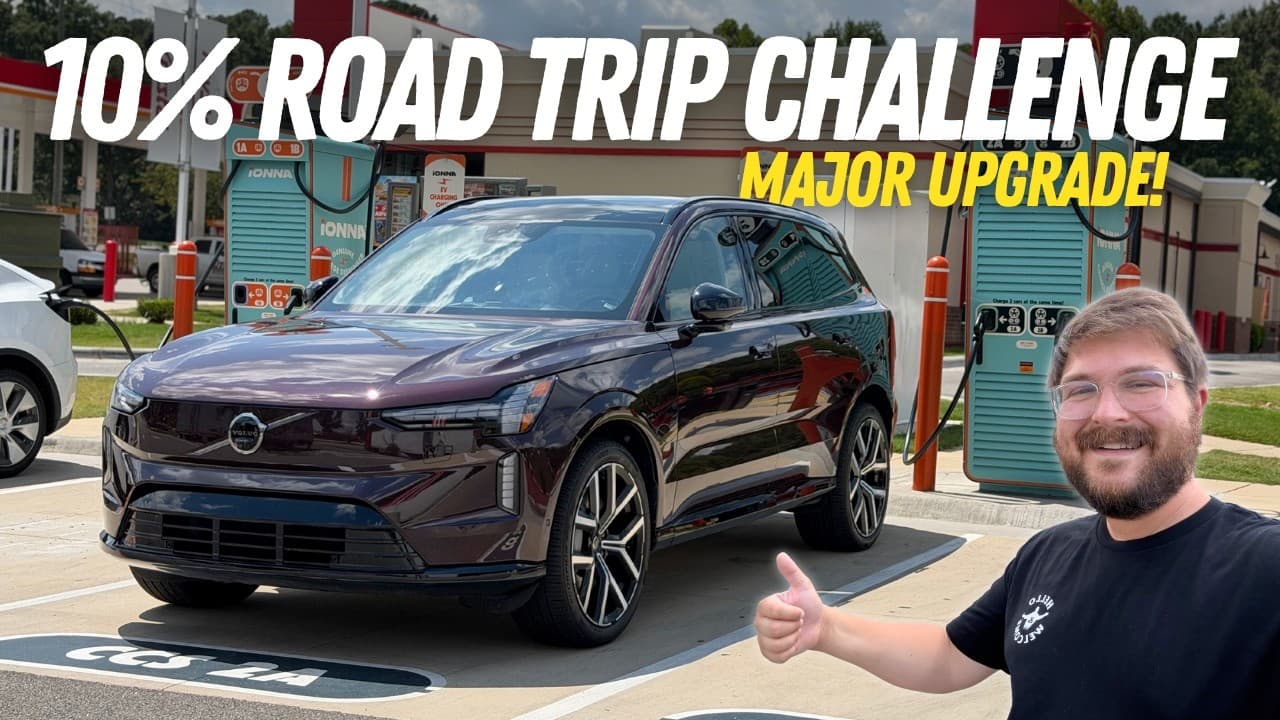
Kyle Conner did not need a press kit to explain the 2026 Volvo EX90. Halfway through a 10 percent charging challenge on Out of Spec Reviews, the car was pulling about 370 kilowatts at 500 amps. That is not a rounding error on last year's brochure. The first EX90 was advertised at 250 kW and, on North American hardware, rarely got there because it asked for more than 600 amps from a 400-volt pack.
The new car is an 800-volt machine wearing the same name. Volvo opened orders in September 2025 with a claim of up to 250 kilometres of range in ten minutes on a 350 kW stall, plus a core-computer upgrade that 2025 owners can have fitted for free at a workshop. Testers have now had the hardware long enough to put numbers on both halves of that promise: the charging, and the highway miles the charging is supposed to restore.
Same badge, different wiring
Conner's walkaround, published 19 August, treated the 2026 car as a quiet product change rather than a facelift. Both generations use CATL nickel-manganese-cobalt cells. The newer pack is wired more in series — he estimated a 192S1P layout, a little over 800 volts at the top of the charge window, possibly around 840 when full. Capacity dropped a few kilowatt-hours. He put the old pack in the 111–112 kWh region and the new one around 107–108; Wes from Out of Spec Testing, on a 70 mph range run published 30 August, called the usable figure about 102 kWh against roughly 107 on the 400-volt car.
That trade is the point. The old EX90 needed about 630 amps to approach its 250 kW peak, a current that most public stalls in the United States simply do not offer. Conner noted the new pack hitting 370 kW at 500 amps. Voltage does the work that current used to. Volvo's own language is more corporate. Anders Bell, chief technology and engineering officer, said the EX90 “now features our most advanced electric system, delivering faster charging and higher efficiency, so you can feel more confident and in control.” The company also deleted the earlier torque-vectoring rear axle and, on Conner's car, the roof lidar; drive is now rear-primary, with a claimed bump of about 130 horsepower.
Volvo's 10-to-80 percent claim for the upgraded car is 22 minutes. MotorTrend's 2025 Twin Motor Performance, still on 400 volts, peaked at 193 kW in the magazine's charging test and needed 43 minutes from 10 to 90 percent in Car and Driver's figures, with an average of 127 kW. Those are the numbers the 800-volt pack is supposed to retire.
What a 15-minute stop actually returned
Conner's 10 percent challenge is a blunt instrument: start at 10 percent, charge for 15 minutes, then hold 80 mph until the pack is back at 10. Midway through the run he was averaging about 2.08 miles per kilowatt-hour, 489 watt-hours per mile, with 55.7 miles behind him. He projected a score around 110 miles for the cycle and said the pack cooling had backed off once the battery reached equilibrium. That is a road-trip number, not a laboratory curve, and it is the first time a Volvo seven-seat SUV has looked plausible on American high-power DC.
The asterisk on Volvo's 250-kilometre-in-ten-minutes line is printed in the press release: times vary with temperature and battery condition, and the figure was taken at 350 kW facilities. Conner exceeded the 350 kW peak on a stall that could supply it. Most drivers will still meet 150–250 kW cabinets. The architecture no longer needs 630 amps to be useful; it still needs a site that can hold high power through the middle of the curve.
The box still has to cut air
Range is the less flattering half. MotorTrend's 70 mph road-trip test of the 2025 Performance, on 22-inch wheels, returned 247 miles against a 300-mile EPA sticker. Car and Driver saw 250 miles at 75 mph. Wes, running the 2026 Twin Motor on 22-inch wheels, told viewers the result was not the class-leading figure he wanted. In the sit-down he cited 262 miles and noted that plenty of rivals now clear 300. He did credit the new pack with better efficiency than the 2.59 miles per kilowatt-hour he recorded on the earlier car, putting the upgraded example around 3.1.
A 7-seat SUV with the frontal area of a small barn was never going to out-range a Model Y. The 800-volt change does not rewrite that. It does change the stop: a car that can take 350-plus kilowatts spends less of a long day on the cable, even if the miles between stalls remain those of a tall, heavy Volvo.
Shoppers on the used lot now have a problem Volvo has not advertised. Two model years share a nameplate and almost none of the electrical architecture. A 2025 EX90 can get the new computer; it cannot get the 800-volt pack, the 350 kW curve or the 500-amp charging math. Conner's line on the update was that Volvo rebuilt the car after one model year and barely told anyone. The charging tests say the rebuild was real. The badge on the tailgate does not.
- https://www.youtube.com/watch?v=AR5c7YhRk9I
- https://www.youtube.com/watch?v=w6kaxT1L5kQ
- https://www.youtube.com/watch?v=4t9VZ61sc18
- https://news.cision.com/volvo-cars-global/r/upgraded-ex90-charges-even-faster-and-delivers-new-and-improved-features,c4252388
- https://www.motortrend.com/reviews/2025-volvo-ex90-ultra-twin-motor-performance-first-test-review
- https://www.caranddriver.com/volvo/ex90
More from the file

The electric trucks at Hannover are ready. Europe's plugs are not
CATL launched a 1,000 km truck battery at IAA Transportation, Scania and BYD brought hardware you can order, and Germany promised 4,200 motorway charging points. Electric trucks remain 3% of the German fleet.

The Escalade IQ's 205 kWh pack is a road-trip cheat code. Overnight, it is a math problem
MotorTrend's long-term Cadillac adds 137 miles in 15 minutes on a DC stall, then needs two nights on a 6.6 kW home charger. Electrek spent $750 filling the same pack across 2,650 miles.

Jeep and Ram's range-extended EVs slip again, and Stellantis says nothing has slipped
The Grand Wagoneer EREV moves from May to November and the Ram 1500 REV to April 2027. Stellantis calls both programmes on track. Suppliers call the extra months validation time.