California wants 9 GW from parked EVs. Germany is selling the kit
GridLab says 10 percent of California's projected EV fleet could cover a third of the state's 2036 long-duration storage target. The cars that can actually export still come as a branded charger, tariff and app.
By EV News Desk
California's next long-duration battery might already have a license plate. GridLab, Kevala and E3 told state planners on 18 August that if 10% of the light-duty electric cars expected on California roads by 2036 joined vehicle-to-grid programs, they could supply about 9 GW of power for 12 hours. That is 108 GWh, more than a third of the long-duration storage the state wants to procure that year.
The arithmetic sits on a California Energy Commission projection: 9.7 million light-duty EVs and more than 110 GW of behind-the-meter pack capacity. "The next generation of grid infrastructure is already sitting in our driveways, homes, and businesses," GridLab executive director Ric O'Connell said with the report. "The question isn't whether California has the resources — it's whether our programs are designed to unlock their full value."
Nine gigawatts is a planning option, not a dispatch stack
The 9 GW figure only holds if a tenth of that future fleet can behave like a grid-scale battery: plugged in, allowed to discharge, and paid for what it actually delivers. Eric Cutter, a partner at E3, said the next programs "must reward participating customers for the measurable value they deliver to the grid and not increase bills for others."
The hardware census is much thinner than the driveway census. The International Energy Agency's vehicle-to-grid analysis, published with Global EV Outlook 2026, counts 22 models with commercial V2G capability, less than 1.5% of EV models. Vehicle-to-home and vehicle-to-load are at least three times as common. Chinese manufacturers produce more than half of EV models worldwide and account for one commercialized V2G car, used in a United Kingdom offer.
At the outlook's launch webinar, IEA analyst Elizabeth Connolly put the system case in one sentence. AI-enhanced charging and bidirectional hardware mean EVs "have the opportunity to become an actor in the power grids" and "more of an asset for energy storage rather than just loads on the grid," which "can also mean that EVs can help reduce the otherwise required grid investments."
Germany is taking orders for a branded stack
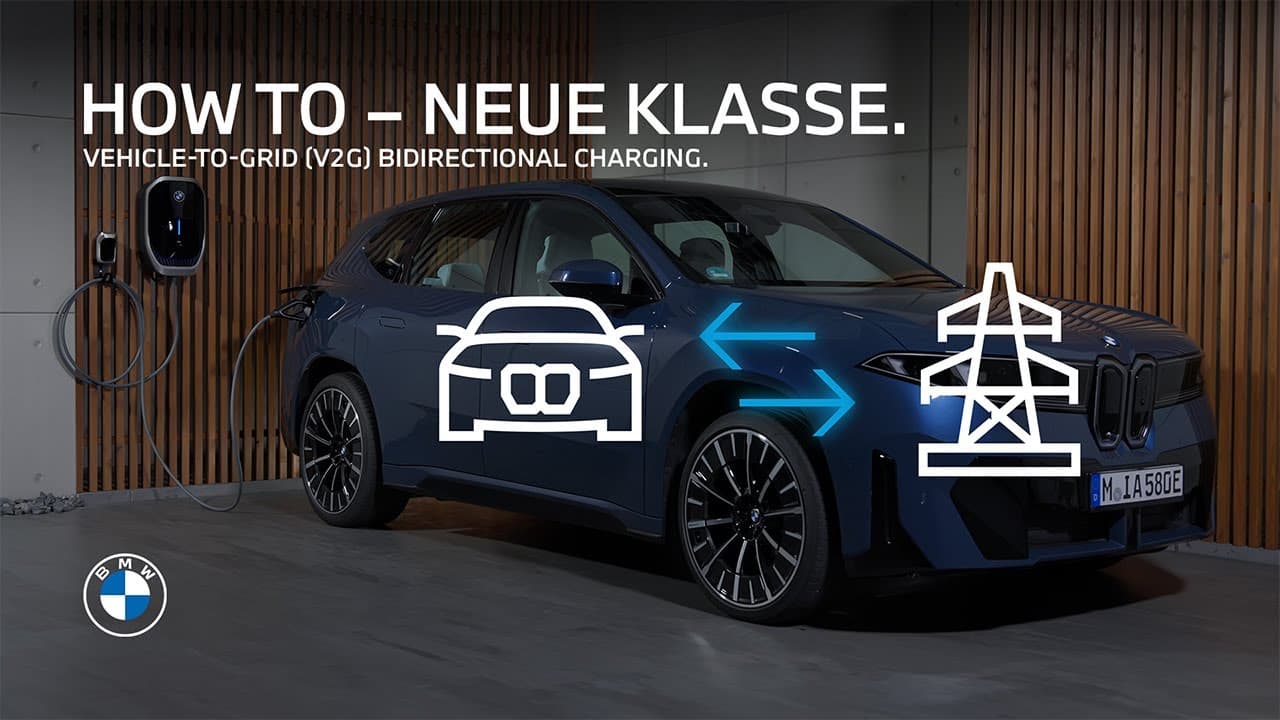
Where California is writing a roadmap, Germany is selling a kit. BMW Group and E.ON opened the country's first commercial V2G package on 9 February: the 11 kW BMW Wallbox Professional, E.ON's ÖkoStrom Home & Drive V2G tariff, and a smart meter, built around Neue Klasse models starting with the iX3. An E.ON presenter on the company's Innovation channel called it "a first commercial V2G product in Germany together with our partner BMW," and said the driver can set in the app or the car "how much energy will be needed for the next trip."
The money is mostly for sitting still. BMW's own how-to video is blunt: "Your participation is rewarded with a bonus payment by E.ON for every hour your vehicle is plugged in, also when no energy is charged or discharged." Twenty-four euro cents an hour, capped at €60 a month or €720 a year, which assumes 250 plugged-in hours a month. Each kilowatt-hour actually exported is paid at 40 cents. The first 100 iX3 buyers who take the tariff get €700 off the wallbox. The official video description adds a constraint the bonus slide does not: V2G is "currently only available in Germany in conjunction with the V2G electricity tariff offered by our cooperation partner E.ON and cannot be combined with a PV system."
Volkswagen is assembling the same bundle at larger scale. Group energy subsidiary Elli is aiming a DC bidirectional charger, the Naturstrom V2G Flow tariff and the Elli BiDi App at Volkswagen, Volkswagen Commercial Vehicles and CUPRA customers in Germany from the fourth quarter of 2026. About one million MEB cars in Europe, including 360,000 in Germany, are described as technically ready. Compatible cars start at ID. Software 3.5 with 77 kWh packs, then every ID. model on Software 6. The plug-in bonus is again up to €720 in the first year, again at 250 hours a month.
"The energy transition needs storage, and much of it is already standing in our customers' garages," Elli chief executive Giovanni Palazzo said at the June Power2Drive unveiling. Thomas Schmall, Volkswagen's board member for technology, said the electric car "can store electricity, charge in a controlled manner, feed energy back and thus also create economic added value while parked." Germany's Bundestag ended double grid fees on electricity stored and later returned, including from bidirectional EVs, at the end of 2025. The IEA treats that change as the reason commercial offers could appear. France, the Netherlands and the United Kingdom already met the agency's checklist for commercial V2G.
The closed system is the commercial form
Amy, presenting for charger maker go-e, described the market that actually exists: early bidirectional service "only works within a closed system: a specific energy provider, a specific charger model and a specific car." That is also the IEA's finding. ISO 15118-20, the CCS communication standard for bidirectional transfer, was published in 2022, and "implementation of the new standard varies considerably between OEMs." Current offers do not cross a national border or a utility fence.
The economics split on the same line. The IEA puts bidirectional AC wallboxes under USD 1,500, with paybacks around two years at roughly USD 500 of annual customer benefit, and DC units at USD 5,000 and up, stretching payback toward a decade. BMW's 11 kW box is the cheaper AC route. Elli's BiDi Charger is DC. Neither is a generic socket you take from one brand to another.
California can treat 9 GW of 12-hour storage as a resource that might live in driveways. A driver who wants to collect it still has to buy the matching wallbox, the matching tariff and the matching software, then keep the car plugged in for hundreds of hours a month. The parked fleet is large. The kit that turns it into a grid battery is still sold as a set.
- https://www.prnewswire.com/news-releases/new-report-californias-path-to-affordable-energy-bills-starts-in-homes-and-driveways-302853525.html
- https://www.iea.org/reports/vehicle-to-grid-technology
- https://www.youtube.com/watch?v=q4xvDnftGck
- https://www.youtube.com/watch?v=-ByVF6nj9Mo
- https://www.youtube.com/watch?v=RdPzoDV7F3M
- https://www.youtube.com/watch?v=AcP43BmbVpc
- https://www.elli.eco/en/about-elli/news/newsroom/vehicle-to-grid-volumenmarkt
- https://www.electrive.com/2025/11/14/germany-clears-the-way-for-bidirectional-charging/
- https://electrek.co/2026/08/18/just-10-percent-of-californias-evs-could-provide-9-gw-of-grid-power/
More from the file
Hyundai gave V2X one global name. The electricity market did not follow
AllDayEnergy will put Hyundai, Kia and Genesis charging services under one badge, but the first release exposes the harder problem: V2X still changes at every border, utility and wallbox.
PG&E's V2X pilot reaches 51 homes, but the approved-hardware maze remains
PG&E has expanded its bidirectional charging pilot from a near standstill to 51 interconnected customers. The fine print shows why turning an EV into a grid asset is still an installation project, not a feature toggle.

The grid scorecard that leaves EV charging ungraded
IREC's 2026 Freeing the Grid report handed one state an A and thirteen an F. Its grades cover exported power, not the load-connection process that can hold up truck charging depots.