
Tesla's rare-earth-free Cybercab motor: what the 5DU shows, and what Tesla left out
An 18 per cent smaller, 25 per cent lighter drive unit with no rare earths is a genuine supply-chain achievement. The efficiency headline is the least important part of it.
By EV News Desk
The most consequential object at Tesla's Cybercab event was not the car without a steering wheel. It was a front drive unit on a display stand that Tesla says contains no rare earth elements at all.
Tesla's claim for it is narrow and specific: 18 per cent smaller, 25 per cent lighter and more efficient than other top-performing drive units. Elon Musk added afterwards that there are no rare earths inside and that getting there was extremely hard. What Tesla did not say is nearly as interesting as what it did.
The trade nobody has been able to avoid
Many electric cars built today use permanent-magnet motors whose magnets depend on neodymium. It is about a kilogram of material per vehicle, and China refines the overwhelming majority of the global supply and makes most of the finished magnets. When export licensing tightened last year, assembly lines in America and Europe slowed while paperwork cleared. A part measured in grams became the industry's tightest chokepoint.
Manufacturers have shipped magnet-free alternatives before — BMW, Renault and Nissan among them — and the physics has always billed them for it: larger, heavier, less efficient. In an electric car that arithmetic runs downhill fast. Worse efficiency means a bigger pack for the same range, which means more mass, which means stiffer springs and bigger brakes.
Tesla is claiming it went the other direction on all three axes at once. That is the part worth scrutinising, because Tesla has not disclosed the magnet chemistry, the efficiency map, thermal behaviour, or cost per kilowatt against a conventional neodymium design.
The missing motor spec sheet
Kyle Conner of Out of Spec Reviews spent about twenty minutes with Tesla engineers around the display units after the unveil, and his walkthrough is the most detailed technical account currently public. He identified the unit as the 5DU — the fifth-generation drive unit, following the 4DU in today's cars — and, notably, said before Musk's confirmation that he was fairly sure it was a permanent-magnet design.
Those two statements are only compatible if the magnets are permanent but not rare earth. Tesla has said nothing publicly about what they are made of.
The design brief Conner described is unusual for Tesla. This motor is not optimised to be the cheapest thing to build; it is optimised to be the cheapest thing to own across a vehicle's service life. It runs lifetime oil. It uses a mechanical oil pump rather than the electric pump in Tesla's other cars, a choice that would normally cost efficiency at medium and high speeds — engineers told him Tesla spent money on the pump specifically to avoid that penalty. Cooling is oil, via an oil-to-water heat exchanger feeding a liquid-cooled inverter, and thermal capacity is deliberately lower than a Model 3 unit because nothing about a robotaxi duty cycle resembles a track day.
Because the Cybercab is front-wheel drive with the motor directly ahead of a two-seat cabin, noise mattered more than power. Conner described an unusual isolation mounting scheme plus an acoustic blanket around the whole unit.
The number that should get more attention
The specification relayed from the presentation is modest: one motor, single-speed reduction, 163 kW. The Electric Viking, walking through the same announcement, made the point that two of these would still add up to 326 kW, which covers essentially everything Tesla sells short of the performance variants.
He also flagged the manufacturing figure, while saying openly that he could not verify it: Tesla claims the motor can be built fully automated in under ten seconds per unit, enabled by flat copper bars pressed into place rather than round wire wound into coils. More copper in the same volume, less resistive heat, dramatically fewer assembly steps.
If that holds, it matters more than the efficiency headline. Electrek made the deflationary case bluntly and correctly: production EV motors already convert 90 per cent or more of input energy into rotation, so whatever Tesla gained is arithmetically small, and the company's decision to quote size and weight percentages while omitting an efficiency percentage rather gives the game away.
Efficiency was never the prize here. Packaging, assembly speed and a supply chain that cannot be switched off by another government's licensing office — those are the prizes.
Context from the rest of the car
The motor is one piece of a vehicle engineered around cost per mile rather than performance. The pack is an 88s6p arrangement of dry-cathode 4680-family cells at roughly 350 volts nominal, built as four short modules, serviceable from underneath rather than through the cabin floor, and specified for 500,000 miles of near-exclusive DC charging on poor roads. Engineers told Conner a Cybercab part-way through a charging session will abandon it and return to service if demand spikes, so state of charge floats against calendar and cycle ageing rather than a fixed target.
The brakes carry no fluid anywhere. No master cylinder, no booster, no lines — electric actuation at each corner. The body arrives at final assembly as pre-built sides, roof and lids rather than a conventional body-in-white. Thermal management runs Tesla's Super Manifold V3, which the company says is about 30 per cent more efficient than a traditional electric HVAC system and 80 per cent robotically assembled.
Certified consumption is around 165 Wh per mile, which would make it the most efficient car Tesla has put on the road. Some of that is a drag coefficient said to be under 0.20 on an unusually small frontal area. Some of it is the 5DU.
Right now the motor exists in a vehicle nobody can buy, built in quantities Tesla has not disclosed. The precedent is the permanent-magnet unit that debuted in the Model 3 and was in most of the range within a few years. Watch whether the 5DU follows the same route into cars people own. That, not the display stand, is when the rare earth question stops being a talking point.
More from the file

Tesla's European Semi puts payload ahead of maximum range
Tesla quotes 550 km at 40 tonnes and 800 kW charging for its European Standard Range Semi. Payload looks promising, but trailer weight and operating conditions matter.
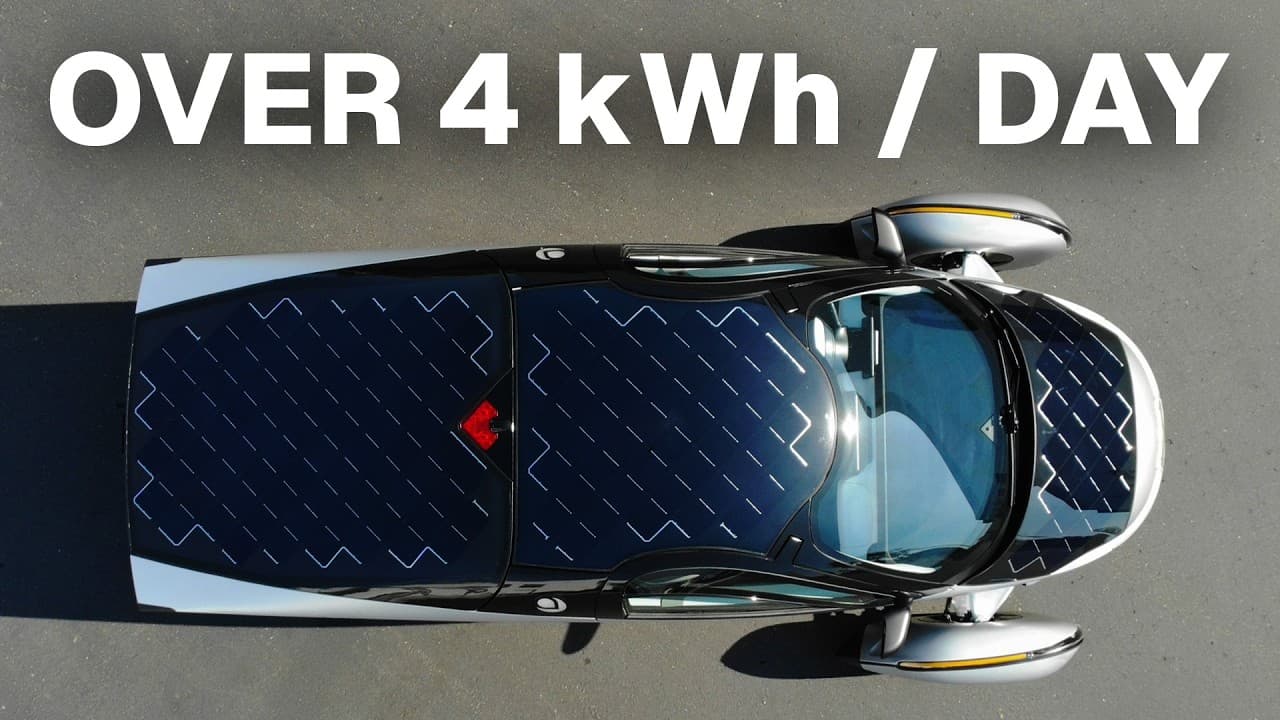
Aptera let an outside lab wire up its solar car. The number survived
TÜV Rheinland spent three days instrumenting every solar string on Aptera's three-wheeler and measured 4.23 to 4.75 kWh a day at the battery — up to 47 miles of driving on sunlight. The solar-yield claim now has independent support. The balance sheet is another matter.