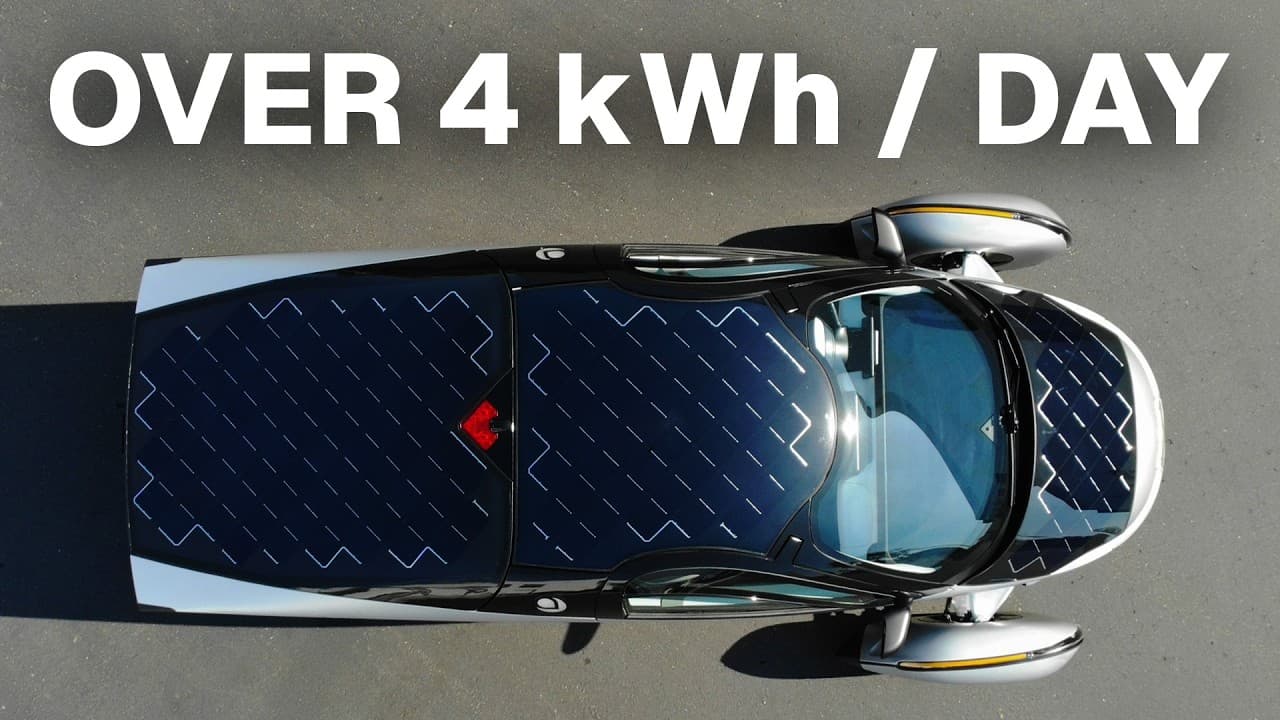
Aptera let an outside lab wire up its solar car. The number survived
TÜV Rheinland spent three days instrumenting every solar string on Aptera's three-wheeler and measured 4.23 to 4.75 kWh a day at the battery — up to 47 miles of driving on sunlight. The solar-yield claim now has independent support. The balance sheet is another matter.
By EV News Desk
Solar cars have a credibility problem, and it was earned. Panels have been bolted to production vehicles for a decade and returned enough energy to run the ventilation fan on a warm afternoon. Lightyear went bankrupt. Sono Motors killed the Sion. So when Aptera says its three-wheeler harvests more than 4 kWh in a day, the correct instinct is to ask who measured it.
Last week the answer stopped being "Aptera". TÜV Rheinland, the German testing and certification house, spent three days at the company's Carlsbad headquarters with its own instruments and reported its findings. The measured solar yield exceeded Aptera's target.
What actually got measured
Dr Giorgio Bardizza, who works on the certification firm's solar team, wired data loggers and sensors to each individual solar string on the car and logged current, voltage and power across full days, while separately monitoring the high-voltage line feeding the pack. This matters, because the number that impresses people on a spec sheet is panel output, and the number that moves a car is what survives conversion into the battery.
“We are trying to confirm the measurements of the power that the car can produce in a day,” Bardizza said in a video the company published alongside the report. He explained why the job needed that much instrumentation: “When you test a solar panel that is flat, it's pretty easy to understand how much power it can get. And even over an entire day, it's a pretty constant production if you track the sun. In this case, the difficulty is that you have a particular shape. So having round solar panels makes everything much more complicated.”
Aptera's body is a teardrop wrapped in cells sitting at every conceivable angle, so string output shifts continuously as the sun crosses. The audit checked two links in the chain: power arriving at the solar charge controller through its MPPT channels, and power leaving it after the boost to the pack's 400-volt level. The stated purpose was to verify that the solar figure the car shows on its own display is the figure genuinely reaching the battery.
Three days, three protocols
The test days were deliberately different, and the differences are the most useful part of the report.
Day one: parked in a single position, hatch closed, untouched. 4.23 kWh. Day two: repositioned once at solar noon, then left alone. 4.40 kWh. Day three: hatch raised to angle more cells at the sun, plus one reposition. 4.75 kWh — a routine Aptera cheerfully calls "solar maxing".
At the company's design target of 100 watt-hours per mile, that spans roughly 42 to 47 miles of driving on sunlight alone. And the day that matters is the boring one.
“The most exciting result is the day we simply parked the vehicle in the sun and let it do the work,” said co-founder and co-chief executive Steve Fambro. He is right to isolate it. A figure that requires the owner to go outside at one o'clock and rotate their car is a hobby. A figure you get by leaving it in an office car park is a product.
Why it works here and nowhere else
The honest explanation is not the solar array. It is the targeted 100 Wh per mile, roughly one-third of the consumption of many mid-size electric SUVs. Fit the same cells to a two-tonne crossover and 4 kWh might buy roughly 12 to 15 miles, not 40-plus.
Aptera earns its number by being a light, narrow, absurdly slippery three-wheeler with a shape dictated by drag rather than by what people want their driveway to look like. That is the trade. The solar story is downstream of the efficiency story, and the efficiency story is downstream of a body that will not suit everyone.
For a commuter whose daily travel stays below roughly 40 miles, that solar contribution could mean days or weeks between plug-ins in favourable conditions. Aptera's own release cautions that weather, location, parking orientation and season will change the result.
The part the report does not cover
TÜV Rheinland measured a solar array under three July test scenarios in Southern California. It did not validate a business.
Aptera, listed on Nasdaq as SEV, issued purchase orders on 4 August for the bodies and chassis of its first 40 production vehicles, with components expected from October under a roughly $44 million programme with manufacturing partner Launch Design. Those 40 cars are targeted for the fourth quarter of this year.
The filings temper that. In its first-quarter results the company disclosed that as of 31 March its cash and equivalents were not sufficient to fund operations for the next twelve months, flagged substantial doubt about its ability to continue as a going concern, and estimated a need for a further $40 million to $45 million. Roughly 50,000 people hold reservations. None of them has taken delivery.
Jonathan Kotrba, a vice president at TÜV Rheinland, framed the exercise carefully: “When American innovation turns sunlight into miles, independent testing helps turn that promise into confidence.” Confidence in the measurement, at least. Aptera has now removed one of the two objections that have followed it for years. The remaining one is not a physics problem, and no test house can certify it away.
- https://electrek.co/2026/08/27/aptera-solar-ev-tuv-rheinland-independent-test-4-kwh/
- https://www.youtube.com/watch?v=3uzuW-YvBE0
- https://ir.aptera.us/news-releases/news-release-details/aptera-solar-electric-vehicle-exceeds-daily-solar-energy-target
- https://www.nasdaq.com/press-release/aptera-orders-bodies-and-chassis-its-first-40-production-vehicles-2026-08-04
- https://ir.aptera.us/static-files/a09ff561-d751-4531-9cc9-ee3f1e4ba96b
More from the file

Tesla's European Semi puts payload ahead of maximum range
Tesla quotes 550 km at 40 tonnes and 800 kW charging for its European Standard Range Semi. Payload looks promising, but trailer weight and operating conditions matter.

Tesla's rare-earth-free Cybercab motor: what the 5DU shows, and what Tesla left out
An 18 per cent smaller, 25 per cent lighter drive unit with no rare earths is a genuine supply-chain achievement. The efficiency headline is the least important part of it.