Three prototypes, four months: inside Slate's race to build a $24,950 pickup
Slate has a working body shop in a converted Indiana printing plant, 180,000 reservation holders and a Q4 delivery promise. The rest of the factory is still coming together.
By EV News Desk
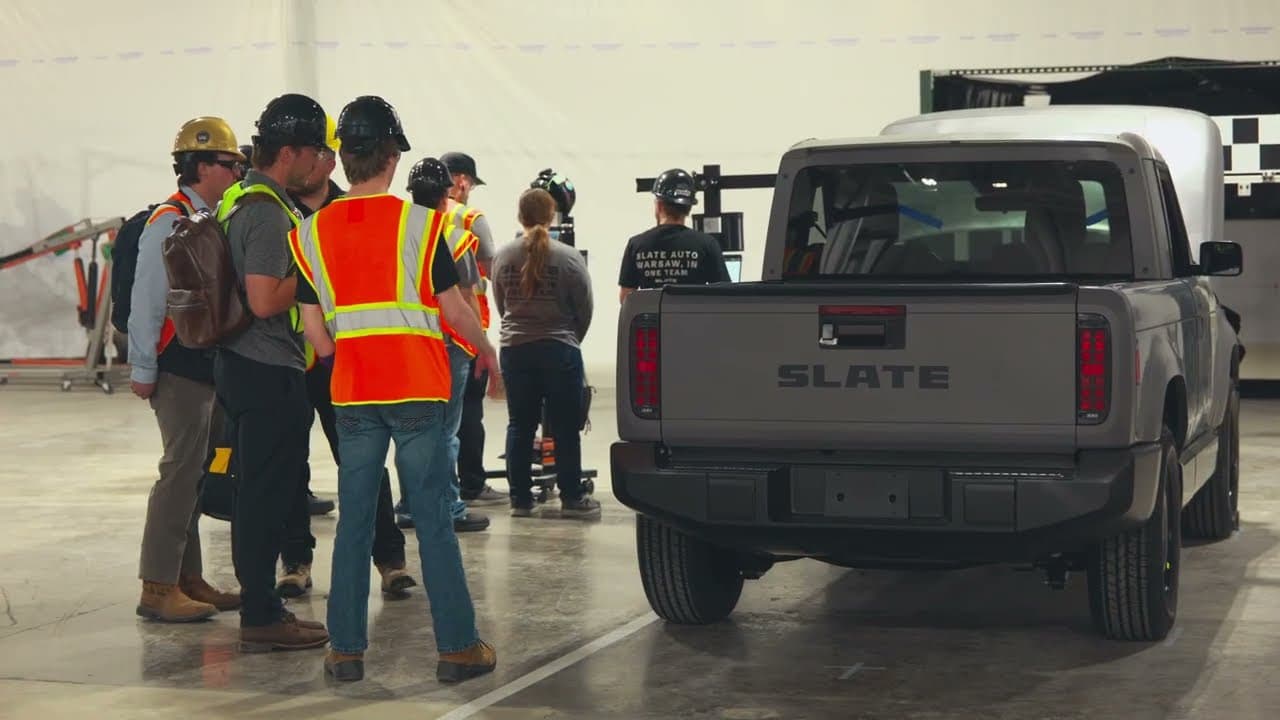
Somewhere in a 1.4-million-square-foot building in Warsaw, Indiana, that spent most of its life printing catalogues, robots are welding together what Slate calls America's most affordable new truck. Assuming it goes on sale.
Slate Auto marked the moment two weeks ago with a 69-second video and the sort of understated boast that only means anything if you know what the acronym stands for. “We've successfully started the build of our next phase of Slate prototypes, and we completed 3 vehicles ahead of schedule,” the company said. That phase is DV2 — a second round of design validation vehicles, built on production tooling, driven until they break, then rebuilt with the fixes. “Our robots are burning the midnight oil,” the narration adds, which is corporate for: the body shop works.
Three prototypes is not a car company. But it is the step immediately before one, and Slate has promised customer deliveries in the fourth quarter of this year. There are four months left.
The $24,950 proposition
The pitch has not moved since Slate broke cover. A single rear motor, 135 kW and 264 Nm, 0–60 mph in a claimed eight seconds. Around 205 miles of estimated range, up 37 per cent on the original figure. Two thousand pounds of towing, 1,550 pounds of payload. No touchscreen. No self-driving hardware. Crank windows — genuinely, in 2026, you wind them down with your arm. Air conditioning and cruise control made the cut.
Price: $24,950, sold direct, with an SUV conversion from $29,950. That figure was confirmed on 24 June alongside the opening of preorders at $300 a head, discounted to $250 for anyone already holding a $50 reservation.
“More than 180,000 reservation holders have told us they're ready for a vehicle that's affordable, reliable, and built around their lives,” chief executive Peter Faricy said in the announcement. “Slate gives customers the freedom to buy only what they need today and personalize their vehicle as their needs change tomorrow.”
Faricy, an Amazon Marketplace veteran who ran SunPower from 2021 to 2024, took the top job in March. Chris Barman, who had been chief executive, moved to president of vehicles — engineering, design, manufacturing, purchasing and quality. Read that swap the obvious way: the founder-engineer keeps building the truck, and someone who has run a direct-to-consumer business at scale takes over the job of converting a reservation list into money.
MotorTrend rode in an early prototype in June and came away liking it. Aaron Gold noted the thing weighs 4,050 pounds, a featherweight by electric-truck standards, and felt quicker than its own eight-second claim suggested.
Warsaw is only partly ready
Barman walked Newsweek through the Warsaw plant in July, and her account is the most useful public read on whether the timeline is real. “The body shop is fully in and functional,” she said. “We're building all our body in whites to process now.” Weld integrity is checked with ultrasonic inspection on sample units before final assembly.
Everything downstream was still arriving. The electrodeposition coating line was around 70 per cent complete — “around the end of summer is when we'll have that up and running,” Barman said. The bonding process was still being done through a supplier in Howell, Michigan, waiting to move into the West building. Four trim lines were installed in general assembly; the chassis lines had started the week before. The seat line went in mid-July. Barman was spending half of every week on site.
Slate is putting nearly $400 million into the former RR Donnelley plant and expects more than 2,000 workers there at full tilt. Local reporting from Fort Wayne on 28 August described an inside look at the facility, with battery pack assembly, seat manufacturing and general assembly all housed under the same roof.
The demand nobody can model
Slate's plan is 150,000 trucks a year by the end of 2027, a number that happens to be roughly the size of its order book. Which is where the optimism has to be handled carefully, because a preorder is not a sale, and this particular company is walking into the worst American EV market in five years.
Cox Automotive counted 77,266 new electric vehicles sold in July, down 41.5 per cent year on year. Ford has killed the F-150 Lightning. Stellantis cancelled the Ram EV. GM has delayed its next-generation full-size electric trucks indefinitely. Electric pickups have borne much of that retreat.
The original $20,000 target assumed the $7,500 federal credit, which expired last September. The $24,950 that replaced it is now the entire argument, and it is a good one: nothing else new in America is close.
Slate's window is the short period in which it can turn a low advertised price into delivered trucks. It has a working body shop, three fresh prototypes, a coating line due imminently, and a delivery promise with a quarter left to run.
- https://www.youtube.com/watch?v=J_ziiFZ262A
- https://www.prnewswire.com/news-releases/back-to-basics-made-to-be-accessorized-over-time-the-24-950-slate-truck-is-the-most-affordable-truck-in-america-302808453.html
- https://www.newsweek.com/slate-accelerates-toward-full-scale-electric-truck-manufacturing-12149591
- https://www.motortrend.com/reviews/first-ride-2027-slate-pickup
- https://techcrunch.com/2026/03/09/slate-auto-changes-ceo-months-ahead-of-affordable-ev-launch/
- https://www.coxautoinc.com/insights/ev-market-monitor-july-2026/
More from the file

China wants 18-month car programmes. Its regulator just pulled the handbrake
Surprise factory inspections, a 4.27-million-vehicle recall and a proposal to double mandatory road testing. Beijing is trying to slow an industry it spent a decade teaching to sprint, and its own executives are split on whether that is possible.
Battery-plant storage pivots run into data-center backlash
Ford and GM are finding grid-storage work for battery capacity built around stronger EV forecasts. Data-center demand offers growth, along with a fast-spreading local political fight.
Ford's Louisville assembly tree is 40% quicker, but nets 15%
Ford says its rebuilt Louisville plant can assemble the $28,350 Fathom pickup 40% faster before added automation and quality checks reduce the net gain to 15%.