South Carolina flattened 1,600 acres for Scout. The bill kept growing
The state promised Scout Motors a finished site in Blythewood. A stalled wetlands permit, idle earthmovers and a wet 2024 added $150 million to the tab, and lawmakers wanted an audit before paying it.
South Carolina did not build the Scout Motors plant. It built the ground underneath it — and that turns out to be the part with the argument attached.
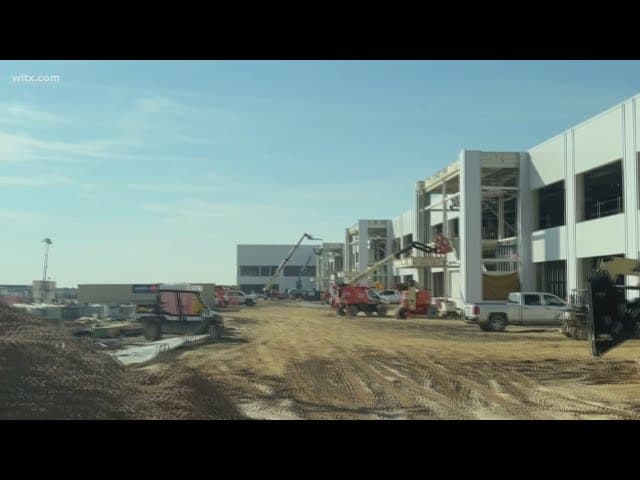
The state agreed in 2023 to hand Volkswagen's revived Scout brand a finished site in Blythewood: 1,600 acres of trees, creeks and steep grade turned into something flat enough to weld a truck on. WLTX's coverage of the project puts the state's outlay at more than $1 billion. What the Department of Commerce has now told lawmakers is that the bill did not stop there. It wants another $150 million — not for Scout, the agency insists, but for contractors who already did the work.
Where the extra $150 million went
The breakdown reported by WLTX is unglamorous and specific. Roughly $72 million covers additional wetlands mitigation plus the cost of halting the job and then accelerating it back onto schedule. Another $17 million went to additional dams. About $43 million is public roads. The last $18 million is the cost of rearranging sequenced construction work and playing catch-up.
The trigger was a permit. Commerce told the station that state natural resources regulators raised issues with the wetlands permit and mitigation plan, and grading stopped for roughly five months. “Work was stopped until January 2024, creating a cost build-up and ultimate budget overrun until the wetlands permit was issued and work recommenced,” a department spokesperson said in a statement to the station, adding that 2024 rainfall was significantly higher than average and contributed further to the delays.
The detail that explains the number best: more than 200 pieces of heavy equipment stayed parked on the site through the stoppage. Mobilised earthmoving plant does not get cheaper while it waits. The money owed runs to the state transportation department, to Richland County, to engineering firm Thomas and Hutton, and to mitigation obligations attached to the federal Corps of Engineers permit.
An audit, a proviso, and a veto
Legislators did not simply refuse the money. They tried to attach a condition. The budget proviso would have required a joint written report to legislative leaders and the governor on Commerce's use of the $150 million tied to the project's infrastructure work, and would have blocked the spending of excess debt service funds until the Legislative Audit Council finished reviewing what caused the overrun.
Governor Henry McMaster vetoed that condition in August, arguing the department had already notified lawmakers of the overruns in January 2025. His framing to WLTX was about creditworthiness rather than accounting:
“You enter into a contract, and somebody has done the work or they brought the equipment to do the work or they've already started, they're part of the way through. If we have a contract, an obligation to them, then we got to keep it.”
Commerce made the same case in commercial terms. “To preserve South Carolina's well-earned reputation for being a top place to do business, it's imperative that we promptly address current and past-due bills,” the agency said, noting in the same statement that “Scout has already hired 850 employees and continues to hire hundreds of South Carolinians.”
Not everyone reads 850 hires as a defence. Representative Jordan Pace of the House Freedom Caucus treats the overrun as evidence against the whole incentive model, and his caucus has called for Commerce Secretary Harry Lightsey to resign. “They were wrong, either wrong about their projections or wrong in their ability to micromanage the scenario,” Pace told WLTX. “And the people should be demanding, and I think will be demanding, accountability.”
Overriding the veto takes a two-thirds vote. Failing that, the budget is ratified and the condition disappears. A separate committee is weighing the funding request alongside hundreds of millions in earmarks, with a decision expected by the end of September.
Scout's position: not our bill
The company has been careful to stand outside the fight entirely. Asked about the request, a Scout representative told WLTX flatly: “We have not had cost overruns. We are certainly not asking for any money to cover cost overruns that we don't have.” That is a defensible line — site preparation was the state's contractual job, not the manufacturer's — and a clean illustration of how these deals allocate risk. The public entity absorbed the permitting and weather exposure. The private one did not.
What the money actually bought
A WLTX tour of the roughly $3 billion construction site earlier this year found crews past the mud stage and working indoors. “Really, what you're going to see now is a lot of HVAC systems going in,” a company representative said during the walkthrough, describing 40-foot-tall structures that will house a body shop, an assembly line, a test track and a drive-through water pit for leak testing. The campus also gets new roads, a welcome centre and its own fire station.
Scout's chief executive, standing in it, described the shift from slide deck to steel: “There's one thing to have PowerPoints live. There's one thing to have a dream and a vision. And then here you can see it come to life.”
Production vehicles were described in that segment as arriving in late 2027 or early 2028. Independent forecasters have been less generous. AutoForecast Solutions has projected the Traveler SUV slipping to late 2028 and the Terra pickup as far out as 2030, a reading Scout rejects; the company says only that “initial production is targeted to begin in 2027,” with customer deliveries in 2028. Analyst Sam Fiorani has tied the forecast shift to Scout's reengineering around Harvester — the range-extender configuration that pairs a battery with an onboard combustion generator.
That last point is the quiet one. South Carolina committed more than a billion dollars of public money, plus whatever the legislature does with the $150 million, to prepare a site announced as an electric vehicle plant. The first vehicles down that line may well carry an engine. None of that makes the grading bills less real. It does change what the state is buying.
- https://www.youtube.com/watch?v=SaP7Gk8dKak
- https://www.youtube.com/watch?v=aKad6TVyFio
- https://www.youtube.com/watch?v=P1ONNpxiq_g
- https://www.carscoops.com/2026/04/scout-terra-traveler-delay/
- https://scdailygazette.com/2026/08/17/sc-governor-vetoes-delay-on-paying-agency-overruns-at-scout-motors-site/
More from the file
Washington Is Rewriting the MPG Rules, and the EV Math Changes With Them
A fleetwide 34.5 mpg target for 2031 instead of 50.4, a quiet reclassification fight over whether pickups count as cars, and a separate rule narrowing heavy-truck standards. What the CAFE rewrite does to the electric side of the business.
China's seven-million-car recall day puts emergency door releases in focus
Door-release recalls cover more than four million cars, led by 2.98 million Teslas. A separate Tesla driver-monitoring action took the day's combined filings above seven million.

Europe's EV battery passport has 71 fields, but buyers will not see all of them
New EU guidance maps the data work behind the 2027 battery passport, and a real limit: access depends on who is asking.