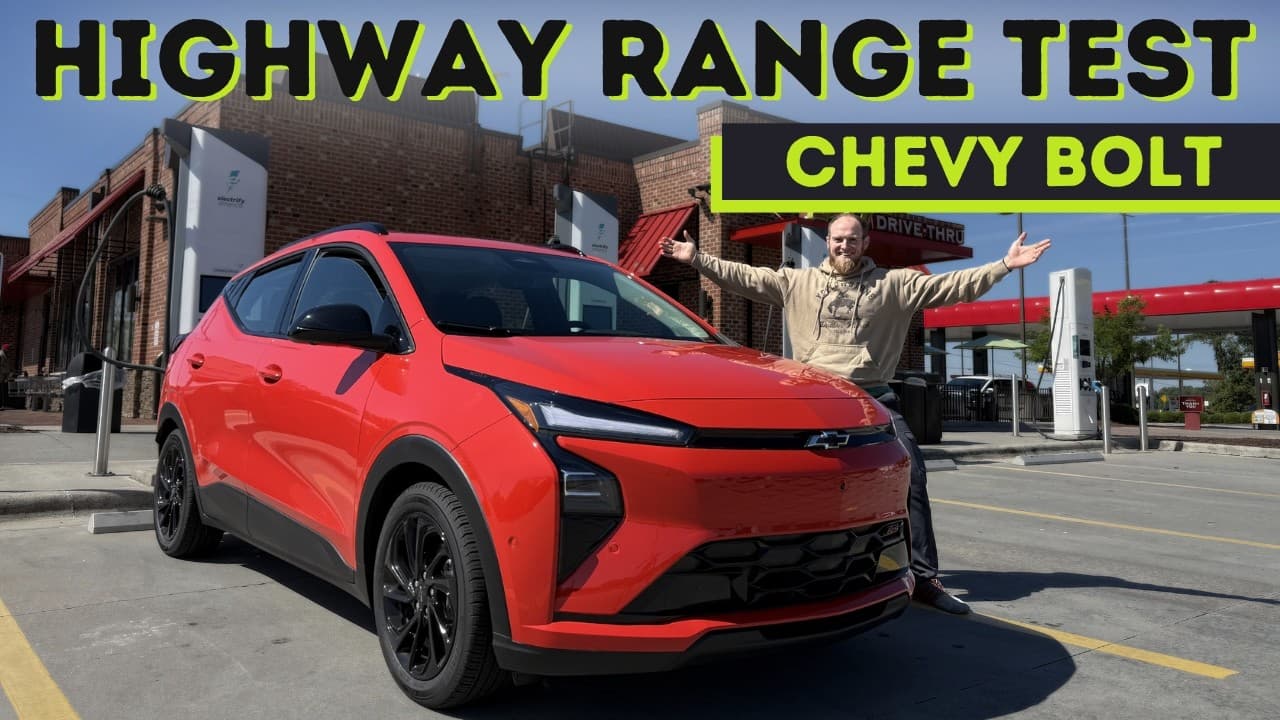
The $30,000 EV range contest changes winner when the road speeds up
Edmunds found 290 miles in the Chevrolet Bolt and 310 in the Nissan Leaf. At steady highway speed, other tests cut those numbers sharply and expose the difference between daily range and road-trip range.
The reborn Chevrolet Bolt can travel 290 miles on a charge, unless it can only travel 217. The redesigned Nissan Leaf goes 310 miles, or perhaps 250. All four figures come from reputable independent tests of the same two affordable EVs. None is necessarily wrong.
This is not a rounding error. It is what happens when a mixed urban-and-highway range test meets a road-trip test that refuses to slow down. For buyers comparing America's two cheapest serious EVs, the test method changes the answer more than the 41-mile gap printed on their EPA labels.
At 40 mph, both beat the sticker
Edmunds' standard route is roughly 60% city and 40% highway, driven until the indicated battery reaches zero. Average speed is about 40 mph. Under that protocol, the 2027 Bolt RS covered 290 miles against its 262-mile EPA estimate and used 26.2 kWh per 100 miles. The 2026 Leaf covered 310 miles in the same testing, narrowly exceeding the 303-mile EPA figure attached to the most efficient S+ trim.
That makes the Leaf the range winner by 20 miles, while Edmunds' direct comparison still chose the Bolt overall. The Chevrolet starts at $28,995 including destination, costs less, feels more agile and replaced the old Bolt's glacial 55 kW charging ceiling with a claimed 150 kW peak. The Leaf counters with more cargo volume, smartphone mirroring and a much more polished cabin.
For school runs, suburban errands and congested commuting, the Edmunds numbers are useful. Aerodynamic drag rises rapidly with speed, while an EV can recover energy in slower traffic. A route averaging 40 mph rewards exactly the work these cars will do most often.
Hold 70 or 75 mph and 60 to 73 miles disappear
The motorway version is considerably less flattering. MotorTrend's constant 70 mph Road-Trip Range test returned 217 miles from the Bolt. Out of Spec Testing independently ran a Bolt RS from full charge until it could no longer sustain 70 mph on a North Carolina loop and landed in the same neighbourhood, about 220 miles.
Car and Driver raised the cruise speed to 75 mph and measured 230 miles. Its Leaf Platinum+ went 250 miles under the same procedure. The result preserves the Leaf's 20-mile advantage, but both cars surrender a large chunk of the range seen on Edmunds' gentler cycle: 60 miles for the Bolt and 60 for the Leaf.
There is an important trim detail inside that comparison. Car and Driver tested the heavier Leaf Platinum+ with a 75 kWh battery and a 259-mile EPA rating, not the 303-mile S+. Nissan's own specifications show how much equipment and wheels matter: the same large-battery range falls from 303 miles in S+ to 288 in SV+ and 259 in Platinum+.
The honest road-trip number is not zero-to-zero
A full-discharge test is still more generous than a normal charging plan. Starting at 100% and arriving at zero uses every mile the car can provide. A driver leaving at 100% and looking for a charger at 10% has about 195 motorway miles in the 217-mile MotorTrend result, or 207 in Car and Driver's 230-mile Bolt run. After the first stop, a conservative 80-to-10% leg is closer to 152 to 161 miles.
The Leaf's 250-mile highway result translates to about 225 miles on the first 100-to-10% leg and 175 miles between 80 and 10%. That is the more practical version of its advantage: roughly 14 to 23 extra miles between stops, depending on the buffer.
Charging can erase some of it. In Car and Driver's test, the Bolt's 65 kWh LFP pack peaked at 148 kW and went from 10 to 90% in 38 minutes, averaging 94 kW. A separate Out of Spec charging session recorded 10 to 80% in 26 minutes, with power above 150 kW early in the session. The Leaf has the larger energy store, but Edmunds found the Bolt restored range faster in their comparison.
Buy for the route you actually drive
The useful verdict is not that one laboratory is right and another is wrong. The Bolt's 290 miles describes mixed daily driving surprisingly well; its 217 to 230 miles describes sustained American highway speed. The Leaf's comparable split is 310 versus 250, with the warning that wheel and trim choice can erase 44 EPA miles before the trip starts.
If most charging happens at home and long trips are occasional, the cheaper Bolt gives away little in everyday range and may spend less time at a fast charger. If repeated highway legs matter more, the Leaf carries a modest but consistent cushion. Either way, a shopper planning around 290 or 310 uninterrupted interstate miles has picked the wrong number from a perfectly valid test.
- https://www.youtube.com/watch?v=VxbIWg4WHiM
- https://www.youtube.com/watch?v=tCeXL7128NE
- https://www.youtube.com/watch?v=MfM8ld8E_Cw
- https://apnews.com/article/bolt-v-leaf-30k-evs-47da3b75fd410218518f96d4c210675b
- https://www.edmunds.com/car-news/2027-chevy-bolt-ev-range-tested-video.html/
- https://www.caranddriver.com/reviews/a70627323/2027-chevrolet-bolt-drive/
- https://www.motortrend.com/reviews/first-test-2027-chevrolet-bolt
- https://www.mynissan.org/static/brand-nissan/Custom_Pages/2026/LEAF/N_26LEAFb_rX.pdf
More from the file

The 2026 Solterra earns a second look, with a motorway-range caveat
Fresh French efficiency testing and an earlier US charging test show why the revised Solterra deserves another look, and why buyers must keep market specifications separate.

Two Independent Tests, One Number: The VW ID.3 Neo Really Does Use 15 kWh/100km
German and British testers put the 58 kWh ID.3 Neo through separate real-world runs days apart and arrived at nearly identical efficiency. That single figure reshapes which battery you should buy.

Rivian's 1,025-horsepower R1T costs $124,000. Its charging is less exotic
The quad-motor R1T is among the quickest vehicles on sale, but it is not especially efficient, tops out at 220 kW and still lacks massaging seats.