
MG claimed 517 km for the Hector Tomahawk EV. Four testers got within 70 km of it
A 100-to-1 per cent drain test in Kochi traffic returned 447.5 km from the Tomahawk's 69.2 kWh pack. The charging ceiling and the suspension are where reviewers start disagreeing.
By EV News Desk
MG claims 517 km for the Hector Tomahawk EV. In India, that kind of number usually functions as a starting bid — something to be discounted by a third once the car meets real traffic. Three separate sets of hands have now put the Tomahawk on the road around Kochi, and the gap between claim and reality is unusually narrow.
Gaadiwaadi ran the strictest test: 100 per cent to 1 per cent, three occupants and luggage aboard for most of it, Eco mode, through the kind of Kochi congestion that swallowed the first 93 km at 50–65 km/h. The car covered 447.5 km before the display conceded, with 4 km of indicated range left. Host Gaurav Yadav rounded the practical figure to about 450 km.
That is roughly 87 per cent of the claim on a single-charge drain test in a city — a result most seven-seat electric SUVs would not survive.
Two more data points, pulling in different directions
The King Indian channel deliberately did the opposite, running the car in Sport mode through hills. After 195 km driven with 242 km still indicated at 50 per cent battery, the projection came to 437 km. The presenter's read was that normal-mode driving on flat roads would close the remaining 70 km and hit the claim outright.
Carandbike's Bilal declined to call a range test at all, on the sensible grounds that a media fleet car driven by several journalists needs a few cycles before its estimator means anything. He published his working instead: 150 km on the trip meter, battery down to 64 per cent, over 310 km still showing. "The actual real world indicated driving range comes to anything between 440 to 460 km," he said, "and that is promising is what I think."
Evo India's reviewer put it more plainly after seeing 500 km indicated at a full charge: for the first time ever, the range is very, very close to the claimed range.
Four independent drives, four figures between 437 and 460 km from a 69.2 kWh pack. That is a tight cluster, and it is the strongest thing about this car.
The charging figure is the one to argue about
The Tomahawk's DC ceiling is 90 kW. Plug into anything faster and it still takes 90 kW, which puts a full charge at roughly an hour. Evo India flagged the comparison directly: rival electric SUVs in this Indian price bracket are already accepting double that. For a vehicle whose whole pitch is long-distance family duty, that is a real constraint — the range gets you there, the charge rate decides how long you sit before coming back.
Pricing runs ₹19.5 lakh to ₹23.5 lakh, with a single battery option. MG also continues its Battery-as-a-Service route: ₹14 lakh up front plus ₹4.9 per kilometre in battery rental.
Where the reviewers stop agreeing
Autocar India's verdict was that the Tomahawk knows exactly what it is doing — a relaxed, spacious all-rounder in the mould of the original petrol Hector, with ride control markedly better sorted than that car's wallowy setup, helped by the battery mass sitting low in the floor. The cabin drew genuine praise: soft-touch materials, contrast stitching, a 15.6-inch screen that works because its wide aspect ratio keeps it low in the dash, and physical redundancies for climate and volume. Third-row space exists and is usable with the middle bench slid forward, leaving 192 litres of boot with all three rows up.
Evo India was considerably harsher on the chassis, arguing the suspension lets the wheel slam and rebound through potholes in a way hydraulic bump stops on rivals do not, and that occupants will feel it within hours. The same reviewer found the regen too weak even on its strongest setting, with a one-to-two-second lag before it engages and nothing at all below 10–12 km/h — which rules out one-pedal driving in exactly the traffic where you want it.
Gaadiwaadi, meanwhile, rated the regen calibration as a benchmark other Indian brands should study for its smoothness, while reserving its complaints for seat comfort on both rows. The two channels are describing the same hardware and reaching opposite conclusions, which is worth knowing before you read any single verdict as settled.
Everyone agrees on torque steer. The 201 bhp and 310 Nm arrive through the front axle in a lump rather than progressively, and Autocar India warned that flooring it on a smooth surface produces wheelspin and tugging that could unnerve a newer driver. Evo India also lost patience with the drive selector on the left stalk, reversing the car five or ten times in a day while reaching for the indicator.
Carandbike's conclusion is the one that stings. MG brought the ZS EV to India ahead of the field, he noted, and the market has matured since. The Tomahawk is priced right, specced decently and comfortable to live with — but it is catching up rather than setting the terms. "Being decent doesn't cut it anymore," he said, "and we expected more from MG by now."
On the range claim, though, MG has done something that deserves noting: it published a number its own test cars can very nearly hit with three people and a boot full of luggage.
More from the file

BMW iX5 demo hit 464 kW. The miles were not measured
At an IONNA session in California the iX5 60 xDrive's display read 464 kW, against BMW's 460 kW claim. Reports of the range added in ten minutes run from 170 miles to more than 210, and none of them is a measured result from that charge.
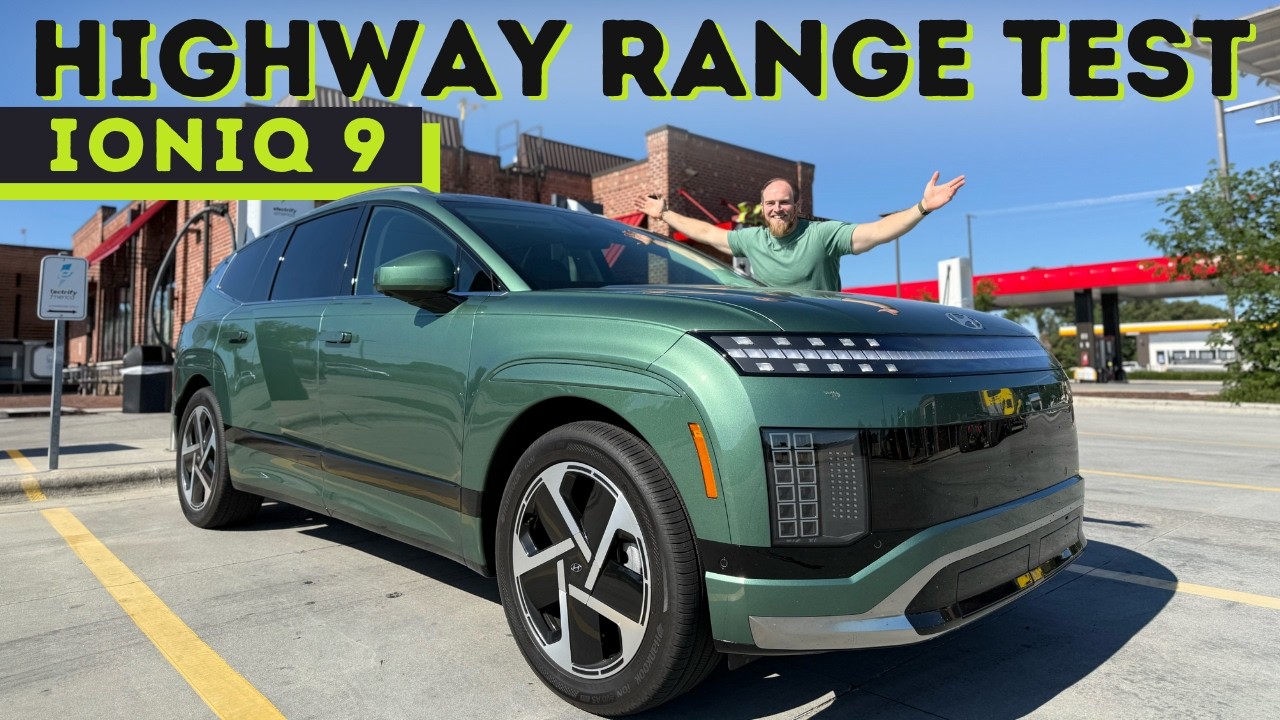
At 70 mph, one Ioniq 9 lost 5 miles. Another trim lost 73.
A Consumer Reports 70 mph test of a 2026 Hyundai Ioniq 9 SEL returned 315 miles, five under its EPA rating. MotorTrend's rear-drive S stopped at 262. Edmunds' mixed-route test beat both stickers.

Škoda's £24,950 Epiq matches its petrol twin on price. You just cannot buy that one yet
The Epiq hits price parity with the Kamiq on paper, but the cheap battery arrives in 2027. Early drives find a 475-litre boot, 4.7 mi/kWh and a thin standard kit list.