
BMW left the adaptive dampers off the iX3. First drivers say it didn't need them
The first Neue Klasse car ships without adaptive damping, air springs or rear-wheel steering, and leans on a single dynamics computer instead. Early testers report where that bet pays and where it does not.
By EV News Desk
There is a line in BMW's iX3 marketing that sounds like a throwaway statistic until you sit with it: the company says 98 per cent of everyday braking happens without the friction pads ever touching the discs. The pedal is there for emergencies and, in BMW's own phrasing, extremely sporty driving. Canadian reviewer Brian Makse spent a week with the car and had the obvious reaction. "Doesn't seem that long ago that we used to call that driving," he said.
That gap — between what the software now does and what the hardware used to do — is the whole story of the 2027 iX3 50 xDrive, the first production car on BMW's Neue Klasse architecture. And the most revealing thing about it is not what BMW added. It is what BMW left out.
No adaptive dampers. No air springs. No rear-wheel steering.
On a 5,038 lb electric SUV starting at $61,500 in the United States, none of those are on the options list at any price. For a company that has sold adaptive damping as a core competence for two decades, that is a conspicuous absence, and Makse framed his test around it: either the software is good enough to replace all of it, or you feel the gap the first time you turn the wheel.
His verdict after a week on Toronto's roads was neither. "The dampers do conventional work and they do it well, which means nothing needed replacing in the first place," he said. Body and wheel control on a reasonable surface he called impeccable, adding that "the damping is so good in this iX3 that to me it makes the lack of adaptive dampers look like a very conscious choice." The bill arrives on broken pavement, where there is no soft setting to hide behind and road noise comes into the cabin.
The Drive's first-drive review reached a similar conclusion by a different road, scoring the car 9 out of 10 and judging that it "works better in almost every way" than the combustion X3 it sits alongside — while flagging a slight lag before regenerative braking engages deeply, and steering marginally less communicative than the petrol car's.
The computer BMW calls the Heart of Joy
The iX3 runs four high-level computers. One of them, the Heart of Joy, owns vehicle dynamics outright: ABS, traction control, stability control and torque distribution, all in a single unit BMW says is roughly ten times faster than the separate modules it replaces. That centralisation is why the steering, the torque split and the body control can all be tuned as one thing rather than negotiated between suppliers.
It is also, by design, invisible. "You never notice it working," Makse said. "Nothing ever shows up that you didn't ask for." Given how many manufacturers have shipped torque-vectoring systems that announce themselves at exactly the wrong moment, that counts as an engineering result rather than a marketing one.
Where the calibration does not fully land is in feedback. Makse found the electrically assisted steering builds weight with speed rather than grip, and described the brake pedal as wooden — precise in modulation, empty of information. "All of the chassis feedback comes through to you through the seat," he said.
Read the range figure carefully
BMW quotes up to 434 miles for the iX3 50 in US trim. That number applies to the 20-inch wheels with the no-cost summer tyre option. Choose differently and the official figure lands between 383 and 399 miles. The 108.7 kWh pack, an 800-volt system, peaks at 400 kW DC and BMW cites 10–80 per cent in 21 minutes on European hardware.
Makse is blunt about how much of that headline matters in North America, where he has repeatedly watched 350 kW chargers hand over 100 to 150 kW and act pleased about it. The 400 kW figure, he said, is "about as useful as the top number on an Eldorado speedometer."
Efficiency is the more honest metric, and here the numbers diverge in a way worth knowing before you order. On a mixed city-and-highway loop Makse measured 3.17 miles per kWh against an EPA rating of 3.1 for his wheel and tyre package — a rare case of a car meeting its official figure. The Drive recorded roughly 2.6 miles per kWh. European owners with six months on the same NA5 architecture, whose threads Makse combed through ahead of North American deliveries, report 2.7 to 3.3 miles per kWh, and he notes the spread tracks wheel and tyre choice more closely than driving style. Those same owners ran their own active noise cancellation tests at highway speed and could not hear a difference with it switched off.
What you are actually buying
Dual motors — 123 kW at the front, 240 kW at the rear — make 463 hp and 476 lb-ft, enough for 4.7 seconds to 60 mph and a 4,409 lb tow rating. There are M badges scattered around the car and no M version of it, which Makse read as a play BMW has been running since the 1990s: "the badge costs them $40 and buys you a story you tell to your neighbour." He also thinks the platform has the headroom for a real one.
The irritations are the kind that show up in month three rather than on a launch drive. The glass roof does not dim and has no built-in cover; the dealer sells one you clip in by hand from the back seat. The head-up display goes dark behind polarised sunglasses.
None of which changes the core finding from the first people to drive it at length: BMW spent its money on the chassis, where buyers cannot see it, and trusted one very fast computer to do the rest. On a good road that bet looks smart. On a bad one you will wish for the dampers that are not on the list.
More from the file

BMW iX5 demo hit 464 kW. The miles were not measured
At an IONNA session in California the iX5 60 xDrive's display read 464 kW, against BMW's 460 kW claim. Reports of the range added in ten minutes run from 170 miles to more than 210, and none of them is a measured result from that charge.
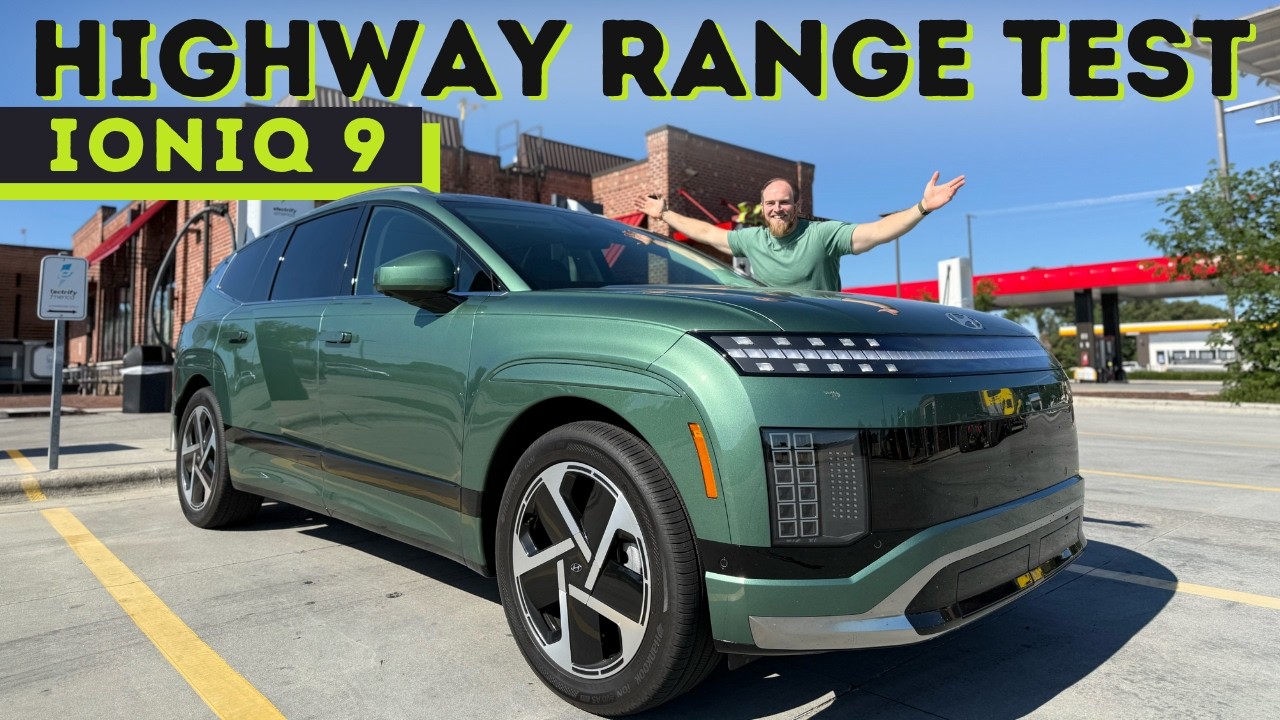
At 70 mph, one Ioniq 9 lost 5 miles. Another trim lost 73.
A Consumer Reports 70 mph test of a 2026 Hyundai Ioniq 9 SEL returned 315 miles, five under its EPA rating. MotorTrend's rear-drive S stopped at 262. Edmunds' mixed-route test beat both stickers.

MG claimed 517 km for the Hector Tomahawk EV. Four testers got within 70 km of it
A 100-to-1 per cent drain test in Kochi traffic returned 447.5 km from the Tomahawk's 69.2 kWh pack. The charging ceiling and the suspension are where reviewers start disagreeing.