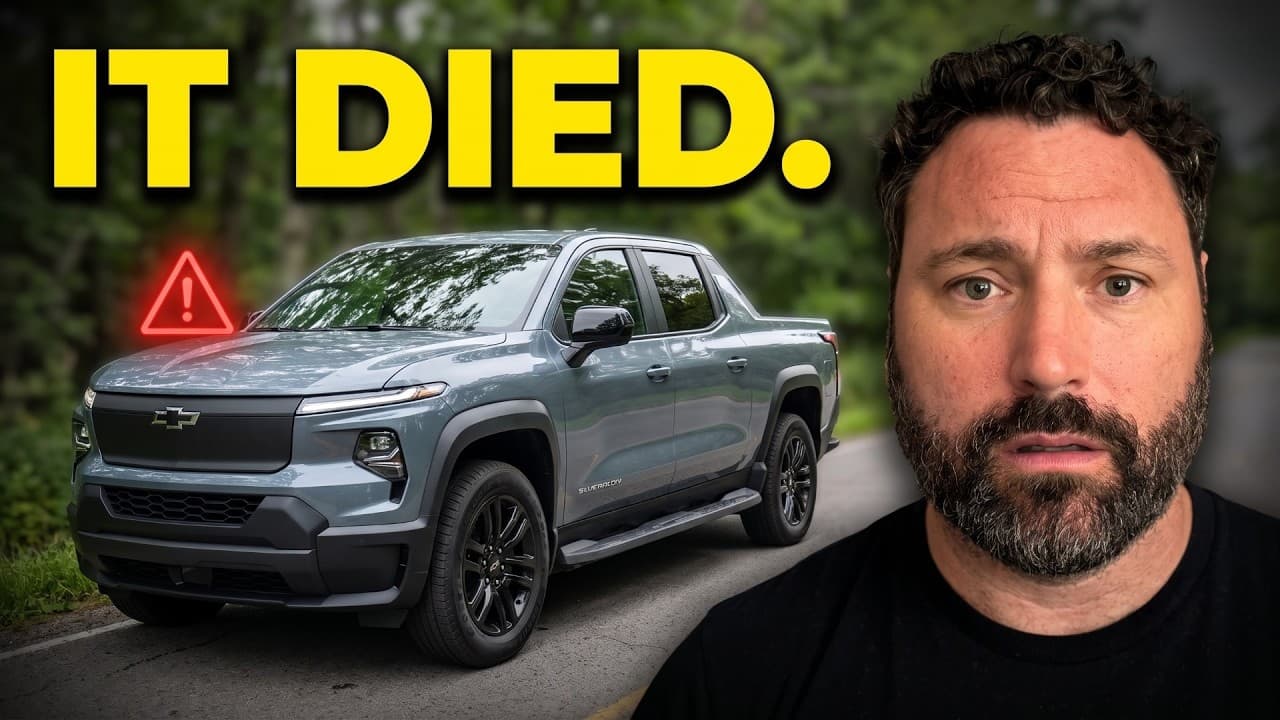
What a Silverado EV Owner Learned About Adapters, Split Packs and a 30-Day Battery Wait
A 2026 Silverado EV pulled 306 kW on an 800-volt charger but fell to about 80 kW through a Tesla adapter. Then it stopped charging entirely, and the month that followed exposed how little owners can learn about EV battery replacements.
By EV News Desk
The plan was boring in the best way: plug a 2026 Chevrolet Silverado EV into a high-power 800-volt charger, then plug it into a Tesla Supercharger, and see which one wins. The first half went exactly as the brochure promises. The second half turned into a month without the truck.
Quebec-based reviewer Outsider Reviews filmed all of it. At a new Flo unit, with the pack preconditioned and the truck sitting at 31 percent, the numbers climbed the way an 800-volt pickup is supposed to make them climb. The vehicle asked for more than 250 kW, then settled at 305 to 306 kW, with the dash calling 25 minutes to 80 percent. GM rates DC fast charging at up to 350 kW on the Max Range pack and 300 kW on the Extended Range, quoting up to 100 miles in 10 minutes in ideal conditions, so a mid-300s peak on a warmed battery is the system working as designed.
Why the Supercharger session looked so different
Same truck, same afternoon, a Tesla stall and a NACS adapter: the session opened near 150 kW and fell to roughly 80 kW within minutes. The reviewer walks through two compounding limits, with an upfront caveat about speaking as an owner rather than an engineer.
The first limit is electrical. The Silverado uses two roughly 400-volt battery layers that can be connected in series for high-voltage charging. At a 400-volt-class Supercharger they remain in parallel, and the reviewer says the truck is limited to about 150 kW. He suspects heat in the adapter contributed to the later slide into the 80s, but the video provides no connector-temperature or current data to establish that. A native NACS port removes the adapter; it does not turn a 400-volt Supercharger into an 800-volt charger.
That second constraint has an expiry date. GM Authority reported in August that the 2027 Silverado EV ships with a factory-installed NACS charge port, following the 2027 Sierra EV, Equinox EV and Blazer EV. Chevrolet is dropping the NACS DC Adapter and NACS Level 2 Adapter from the accessory catalogue outright and replacing them with the inverse — a J1772 AC adapter and a CCS1 DC adapter for older infrastructure. Anyone buying a 2026 truck is buying into the adapter year of a two-year transition.
Then the truck stopped taking a charge at all
An hour of driving after the Supercharger session, nothing. Six hours parked at the in-laws, and the wake-up was a high-voltage fault, a charging-unavailable message and no one-pedal drive. Five ignition cycles did nothing. Disconnecting the 12-volt negative terminal for 15 minutes did nothing. On the drive between destinations the truck served up reduced acceleration, dropped the battery percentage from the display entirely and engaged turtle mode, while still holding the 90 km/h limit.
What followed was 30 days at the dealer and a complete high-voltage battery replacement under warranty, with a loaner Equinox EV throughout — which, as the video notes, Quebec's lemon provisions make less of a favour than it sounds.
The honest part of the follow-up is the part worth repeating. The reviewer canvassed Silverado EV forums and owner groups and tracked down roughly 40 battery-replacement cases spanning model year 2024 to now, three of them repeat replacements, then checked whether those owners shared a charging habit — DC fast charging frequency, Supercharger use, anything at all. Nothing lined up. A GM press contact was emailed three times to ask whether the company tracks these cases, and did not reply.
The account of the service-side procedure is the most concrete thing in the video: a technician opens the pack and runs a swab test for coolant residue, and a positive result closes the case immediately — pack sealed, replacement ordered, the old unit shipped off for engineering diagnosis. Absent residue, the reviewer understands cell-level repair is on the table, and concludes that thermal management is implicated — explicitly labelled a personal deduction rather than a finding.
The recall that is not this story
GM did issue Safety Recall N262562600 in August covering certain 2026 Silverado EV and Sierra EV models, plus Cadillac Escalade IQ and IQL models built on the same battery design. The defect is a manufacturing one: an internal battery module component that, in GM's wording, "may not be fully secured in place." Components that are not properly secured "may move and cause internal damage to the battery," and affected batteries "have increased risk of a fire." The remedy is a complete high-voltage battery replacement at no cost, performed only by technicians who have finished GM's required EV service training, with dealers barred from selling or trading affected stock until the work is done.
The scale, though, is tiny. The dealer bulletin names four affected Silverado EVs and one Sierra EV. That is a contained assembly-line escape, not a fleet-wide pattern, and it should not be stretched into an explanation for owner-reported failures elsewhere. GM has published no numbers on out-of-recall pack replacements, and until it does, the 40-odd forum cases stay exactly what they are: forum cases.
What an owner does with all this
The charging half is actionable today. If your 800-volt truck is running an adapter, treat Supercharger stops as a convenience option rather than a speed option, and expect a hot-day session to look worse than a mild one. Route to 800-volt hardware when the schedule matters, even at a premium per kWh. That is the reviewer's own conclusion after the repair, and the truck's case on range still holds: more than 680 km from an Extended Range pack, and no plans to shop elsewhere.
The reliability half is not actionable, because the data does not exist publicly. That is the real complaint here. An owner who loses a vehicle for a month can find out precisely what the dealer did, and nothing whatsoever about whether it happened to eleven people or eleven hundred.
- https://www.youtube.com/watch?v=n9JG8oH54Ds
- https://gmauthority.com/blog/2026/08/chevy-silverado-ev-gmc-sierra-ev-recalled-for-unsecured-battery-component/
- https://gmauthority.com/blog/2026/08/2027-chevy-silverado-ev-getting-nacs-charge-port/
- https://www.techtimes.com/articles/322986/20260804/silverado-ev-trail-boss-off-road-tested-gm-cuts-2027-lineup-seven-configurations.htm
- https://news.gm.com/home.detail.html/Pages/topic/us/en/2026/aug/0813-electric-vehicle-nacs-charging.html
More from the file
A plumber tested an electric van for two weeks. Overnight charging decided the verdict
Public rapid charging made an electric van only slightly cheaper than diesel at 20–22p a mile. A full overnight charge cost about £6.
Mahindra calls it battery-as-a-service. Its small print calls it two loans
Mahindra's EV prices look up to ₹10 lakh lower under BaaS, but buyers own the battery, repay it for as long as eight years and do not pay by distance.