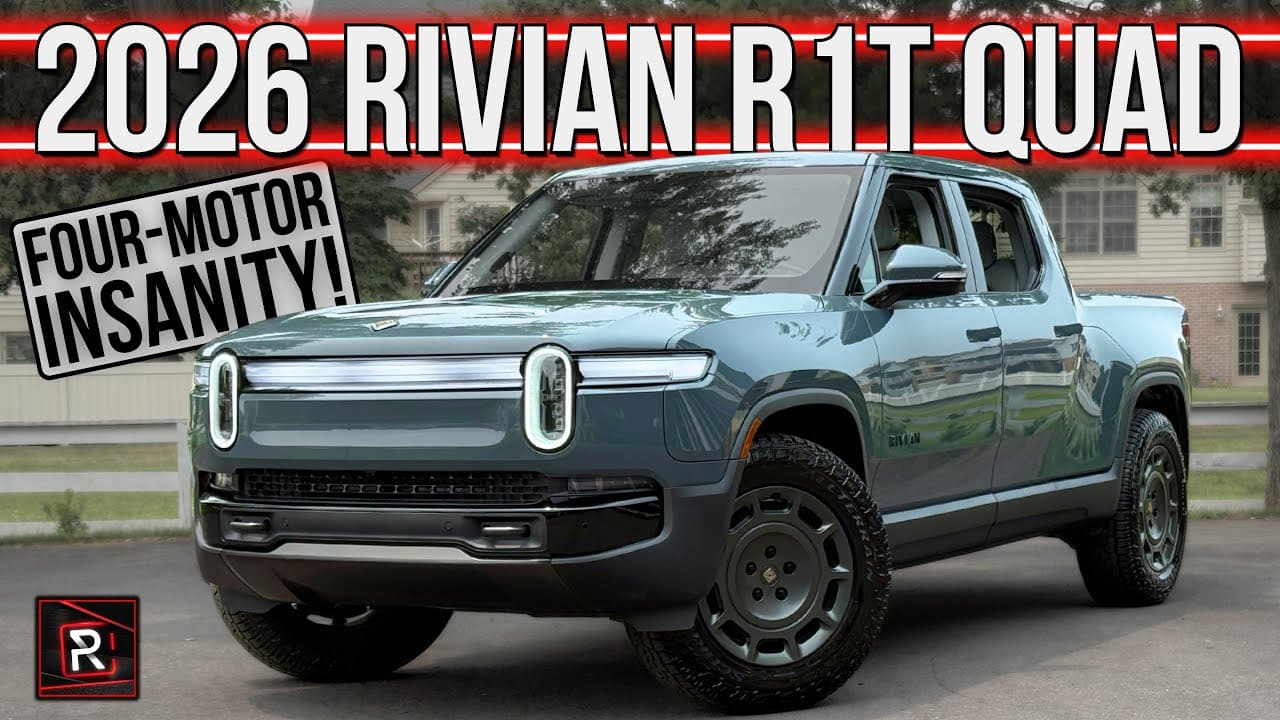
Rivian's 1,025-horsepower R1T costs $124,000. Its charging is less exotic
The quad-motor R1T is among the quickest vehicles on sale, but it is not especially efficient, tops out at 220 kW and still lacks massaging seats.
By EV News Desk
Rivian's quad-motor R1T does a party trick called kick turn. Put it in all-terrain mode, hold both steering wheel buttons in the direction you want to go, feed in accelerator, and the truck pivots on the spot while a readout counts the degrees. EddieX filmed himself doing it in snow and gravel and sounded delighted. It only works on loose surfaces — tarmac has too much grip — which is a neat summary of the whole vehicle. Enormous capability, narrow window in which to use it.
Redline Reviews spent a week with the 2026 version and put the number on the windscreen first: base price for a quad R1T is $115,990, and their test truck, with a $3,000 interior upgrade, a colour upcharge and destination, landed just under $124,000.
What a thousand horsepower reads like on a spec sheet
Four motors, one per wheel, roughly 256 horsepower apiece for a total of 1,025 and 1,198 lb-ft. The first-generation quad system used Bosch motors and made 835 horsepower; these are Rivian's own design, and the reviewer described the extra 190 as a big step rather than a rounding error. Rivian quotes 0–60 mph in about 2.5 seconds and a 130 mph top speed. Redline's best run was 2.8, on all-terrain rubber, and the tester reckoned the right wheel and tyre package would find the missing three tenths.
EddieX, driving in snow on wet roads, managed 3.3 seconds and noted the truck was fighting for traction the entire way. CarGurus, testing in dry weather, got under three seconds and called it as quick as a Cybertruck and one of the fastest accelerating vehicles ever sold. All three arrived in the same neighbourhood by different routes.
The range and charging picture is the ordinary part
Rivian rates the quad between 325 and 374 miles depending on wheels, tyres and options. Redline's truck carried the 325-mile rating, and over a week of ordinary driving the best they saw was just shy of 300. Conserve mode added about 20 miles. That is a respectable real-world result and roughly what the rating implies once you subtract normal highway penalties.
What it is not is efficient. CarGurus said so bluntly, and the comparison Redline reached for makes the point: the GMC Hummer EV carries a pack nearly twice the size and gets to about 363 miles. Two very heavy trucks arriving at similar answers by different means is not a compliment to either.
Charging is where the quad looks conventional next to its acceleration. It accepts up to 220 kW and covers 10 to 80 per cent in around 30 minutes; CarGurus framed it as roughly 150 miles in 20 minutes, which is the more useful way to think about a road trip stop. The onboard AC charger is 10 kW, so a full replenishment at home runs to about 12 hours. Nothing here is class-leading. On a $124,000 vehicle, it is a reminder that Rivian spent its money on motors.
Living with it
The second-generation R1T ships with a native NACS port, and EddieX kept returning to what that changed on a five-hour winter run to the Chicago suburbs. The built-in navigation planned the route, the truck preconditioned itself on approach, and it pulled into a Tesla station and charged without an adapter — then, when the Supercharger stalls were full, he used an adapter in the other direction to reach an Electrify America stall. He described charging as simply fine, which for an electric pickup in cold weather is higher praise than it sounds.
He was more enthusiastic about the driver assistance. The Gen 2 hands-free highway system, he said, was a huge step over the first generation, which he had tried once and switched off for good. He drove hands-free for long stretches of the trip and rated the cameras, sound system and infotainment as genuinely pleasant to live with.
The complaints were small. Redline and CarGurus independently questioned why a truck at this price omits massaging seats. Redline noted the rear seat is usable for a family but not generous, and that a full-size electric truck at similar money offers considerably more of it. Towing runs between 7,700 and 11,000 pounds, and CarGurus warned that range will plummet when you use it.
Who is this actually for
Redline's verdict was that mid-$80,000s makes the R1T a good buy — which is to say the dual-motor or tri-motor trucks, not this one. The dual runs 533 to 665 horsepower with ratings from 270 to 420 miles. The tri makes 850 and is rated at 371. The tri-motor Redline tested last year hit 60 in 2.8 seconds, the same figure the quad managed on their surface. If you want the number to be 1,025 and you want the kick turn, that is what the extra thirty-odd thousand buys.
The more interesting question hovering over all of this is what happens to it. Redline said outright that they want Rivian to capture this magic in an R2 truck, priced for people who are not spending six figures. The R1T Quad reads best as an existence proof: four in-house motors, individual wheel control, 1,198 lb-ft, and a truck that is quiet and comfortable enough that a reviewer's main gripe is the seats do not knead his back. Whether that engineering ever reaches a $50,000 pickup is the part worth watching. For now it costs $124,000 and spins in circles in the snow.
More from the file

The 2026 Solterra earns a second look, with a motorway-range caveat
Fresh French efficiency testing and an earlier US charging test show why the revised Solterra deserves another look, and why buyers must keep market specifications separate.

Two Independent Tests, One Number: The VW ID.3 Neo Really Does Use 15 kWh/100km
German and British testers put the 58 kWh ID.3 Neo through separate real-world runs days apart and arrived at nearly identical efficiency. That single figure reshapes which battery you should buy.
The $30,000 EV range contest changes winner when the road speeds up
Edmunds found 290 miles in the Chevrolet Bolt and 310 in the Nissan Leaf. At steady highway speed, other tests cut those numbers sharply and expose the difference between daily range and road-trip range.