Range Rover Electric fits 118.5 kWh into the old body. Clearance is the cost
Range Rover kept the shape, cabin and off-road brief, then fitted a double-stacked battery and 350 kW charging. Early drives show what survived, and what still needs proving.
By EV News Desk
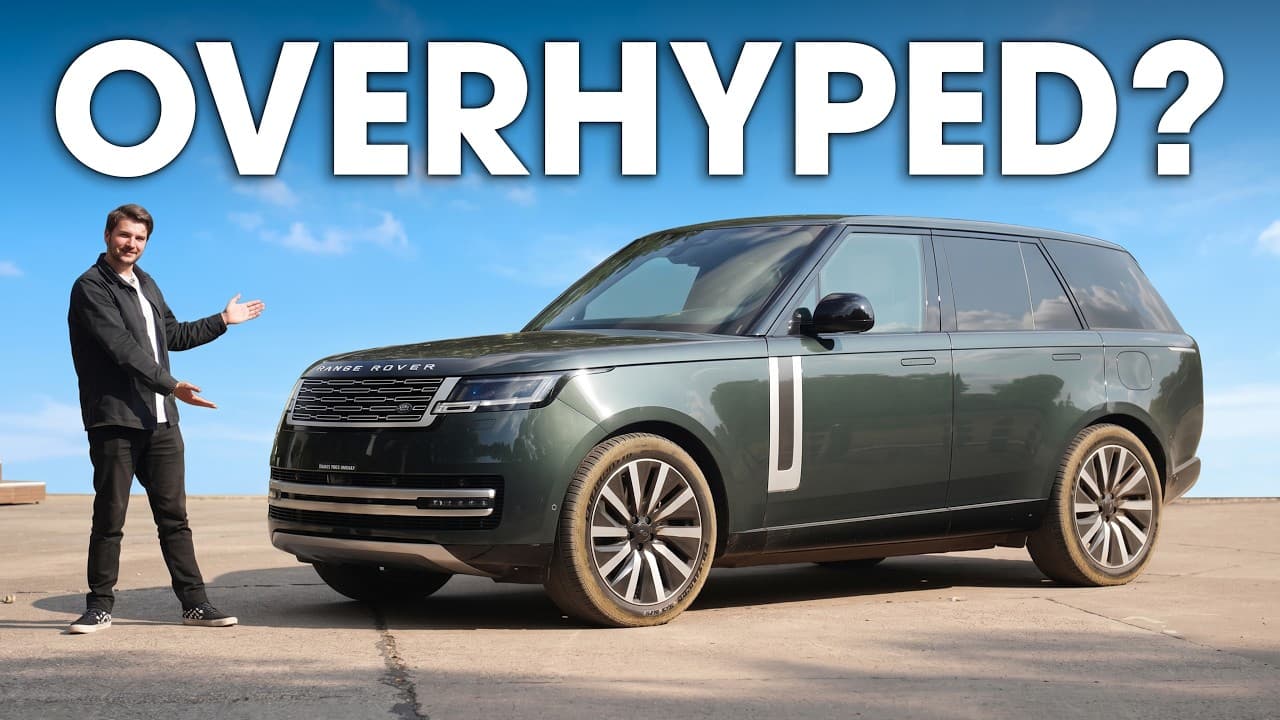
The first production Range Rover Electric looks almost exactly like the combustion model beside it. That is not laziness. It is the visible result of a difficult brief: fit 118.5 kWh of usable battery into an existing luxury SUV without surrendering its boot, its wading depth or the soft-edged ride for which buyers pay at least £154,070.
Range Rover opened orders on 2 September after a launch delayed by about a year. The finished EV has two 260 kW permanent-magnet motors, 850 Nm of torque, an 800-volt electrical system and a claimed 372 miles of WLTP range. JLR quotes a real-world figure of up to 333 miles, which US coverage has treated as the EPA estimate, and US pricing starts at $138,000 before destination. First customer cars are expected in 2027.
The battery had to fit the Range Rover, not the reverse
JLR calls the 344-cell pack double-stacked. The cells sit in two layers where packaging permits, allowing the battery to occupy the available depth without forcing a conspicuously taller floor. That matters because the electric model shares the MLA-Flex architecture, dimensions and Solihull production line with petrol and plug-in-hybrid Range Rovers.
The cabin is meant to feel unchanged. Autocar found very little difference inside, and What Car? said the only packaging hit on interior or boot space is the missing seven-seat option: there is nowhere to put a third row's feet. Ground clearance is the clearer concession. Autocar records a 29 mm cut versus the combustion car; Ars Technica puts the electric model's maximum at 10.3 inches, 1.2 inches below the V8.
That is a more revealing compromise than the nearly blank grille or aerodynamic wheel covers. Range Rover has retained a 900 mm maximum wading depth and says the vehicle can climb a 45-degree slope, yet the battery does take away some clearance. Early off-road demonstrations were conducted on JLR's own Gaydon course, not an independent comparison route.
A 22-minute claim carrying a large asterisk
The charging headline is 10 to 80 per cent in about 22 minutes on a sufficiently powerful 350 kW charger, or 137 miles of WLTP range added in 10 minutes. Moving 70 per cent of the usable pack means delivering roughly 83 kWh in that stop, an average near 226 kW before losses. That is ambitious but arithmetically plausible for an 800-volt system. Neither launch drive independently recorded a charging curve, so the peak, average and repeatability remain manufacturer claims.
JLR's split-charging design is intended to make the big pack less fussy at older hardware. On a 400-volt charger the 800-volt battery can be divided so the two halves charge in parallel, rather than depending on a heavy onboard voltage booster. A second, low-speed AC port on the opposite side from the DC outlet is optional, a small luxury that could matter more in a tight garage than another paint finish.
The pack's size creates a mundane ownership question. JLR offers 22 kW AC charging in relevant markets, but a common 7 kW home supply would need about 17 hours to replace the full usable capacity before charging losses, and longer once they are included. Most owners will not arrive home at zero, though anyone moving from a smaller EV should check the overnight window rather than assume the wallbox will keep up.
The prototype drives found the right character
On road, Autocar said the electric Range Rover feels much like its combustion counterparts, only smoother through the drivetrain, with regeneration ranging from almost a freewheel to single-pedal braking that will hold the car at a stop. Chasing Cars, after a brief Gaydon run, noted quite a bit of corner lean and liked it: this is still a luxury barge, not a sports SUV. On Gaydon's rock crawl, Autocar found the instant torque far easier to meter than a combustion driveline's slack.
Each motor can be controlled far faster than a mechanical driveline, and JLR says its traction system reacts in as little as 50 milliseconds. Rear torque can be varied from all to none, while 7.3 degrees of rear steering tightens low-speed manoeuvres. The quoted 0-60 mph time is 4.3 seconds, quick enough that restraint is the more relevant engineering job.
JLR vehicle engineering director Matt Becker said: “The defining characteristic of Range Rover Electric is its ability to perform across every surface, with effortless comfort and refinement.” The launch drives support the refinement half of that sentence. The harder proof will come from owners towing, fast-charging twice in one day and using the 900 mm wading claim after the warranty paperwork has become their own.
Familiarity is both the product and the risk
The Electric is not an efficiency-first clean-sheet EV. At around 2,885 kg in Autocar's published specification, it moves nearly three tonnes before passengers, and JLR's 333-mile real-world estimate implies the large pack is buying distance partly through capacity rather than exceptional thrift. Range Rover has instead spent its engineering budget protecting the existing car's character.
That decision makes sense for buyers who asked for a Range Rover without an engine, not a science project wearing the badge. It also leaves fewer excuses. The cabin, utility and off-road controls already appear intact. Now the 22-minute charge and 333-mile real-world estimate have to survive testing away from Gaydon.
- https://media.jlr.com/range-rover/news/2026/09/range-rover-electric-new-era-original-luxury-suv
- https://www.youtube.com/watch?v=0hY9TKgmUV4
- https://www.youtube.com/watch?v=v94BiJ9i6Uc
- https://www.theguardian.com/business/2026/sep/02/range-rover-launches-first-electric-vehicle
- https://www.autocar.co.uk/car-news/electric-cars/range-rover-goes-electric-%C2%A3154k-372-miles-range-and-2885kg
- https://arstechnica.com/cars/2026/09/range-rover-ev-electric-propulsion-pairs-perfectly-with-this-luxury-suv/
- https://www.chasingcars.com.au/reviews/large-suvs/range-rover-electric-2027-review-international-first-drive/