Hyundai's 600-mile Santa Fe is an EV with a generator, built in Alabama
Hyundai has put a series-hybrid Santa Fe on the 2027 U.S. calendar at more than 600 miles of combined range, with a pack under half the size of a comparable EV. Genesis follows at 640.
By EV News Desk
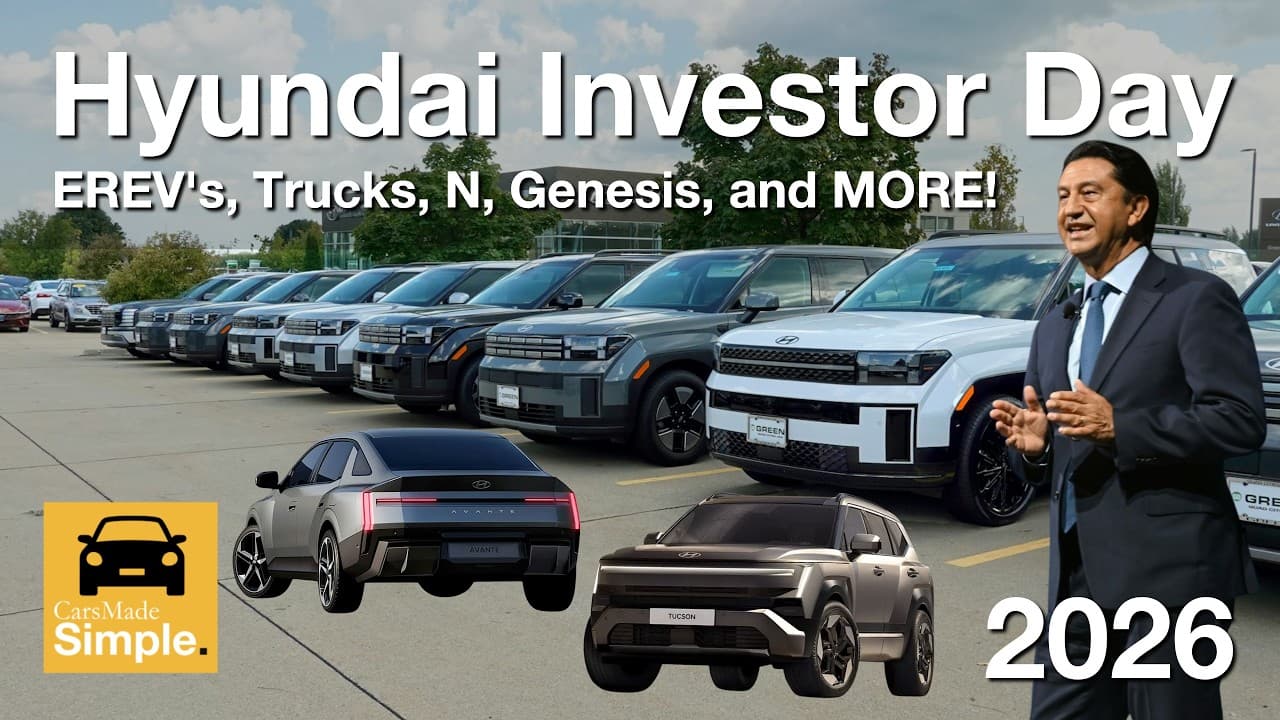
Hyundai did not spend its 26 August Investor Day asking Americans to trust a bigger battery. It offered them a generator. The company's first extended-range electric vehicle is a Santa Fe: two electric motors, a battery Hyundai says is less than half the capacity of a comparable EV's, and a combustion engine that exists to make electricity rather than turn the wheels. José Muñoz, the president and CEO, framed the day around breadth rather than one drivetrain — “more than 100 new models to market by 2030 with multiple powertrain options” — and the Santa Fe EREV is the model that shows what “multiple” is now doing for him in North America.
The headline figure is more than 600 miles of combined range, about 1.6 times a gasoline Santa Fe, due in North America in the first half of 2027. Motor1 reports assembly beginning early next year at Hyundai Motor Manufacturing Alabama, alongside the regular midsize SUV. Genesis follows with its own EREV in early 2027, aimed at more than 640 miles. Neither pack size, engine displacement nor electric-only range was published.
A small pack that is supposed to drive like an Ioniq 5
The usual problem with an EREV is that output scales with how much battery you carry, so a small pack means a slow car. Hyundai's answer, presented by the electrification energy-solutions unit under Chang Hwan Kim, is an in-house cell the company says delivers more than double the output of the high-nickel cells it used previously while cutting charging time by 40 percent. Those high-performance cells go into the 2027 EREV, which the release says uses less than half the battery capacity of a comparable EV “while delivering equivalent battery performance and EV driving dynamics”.
That is a slide until a production Santa Fe is on a dyno. It is also the reason the 600-mile number is not a 200 kWh slab under the floor. Motor1's Adrian Padeanu read the dual-motor layout as all-wheel drive, with the combustion engine acting as a generator rather than a mechanical path to the wheels — the series-hybrid arrangement that made the Chevrolet Volt and BMW i3 REx a niche, and that now fills Chinese showrooms. Electrive noted that Hyundai no longer repeats the old target of two million pure battery cars a year by 2030. Electrified vehicles are still supposed to be 60 percent of the mix, up from 23 percent in 2025, with hybrids carrying more of the weight.
The market that made the generator look cheap
North America is where Hyundai's hybrid story became a volume story. Cumulative hybrid sales there have passed one million. Hybrids are guided to half of regional sales by 2030, from more than ten models, built in Alabama and at the Metaplant in Georgia. First-half U.S. deliveries were 489,656, up 3 percent. Ioniq 5 sales rose 9 percent in that half; the tax-credit hangover that flattened much of the American EV aisle did not flatten Hyundai's hybrid aisle.
An EREV slots into that gap with a straight face. Daily driving can be electric. A long trip is a petrol stop, not a 30-minute DC hunt with a three-row SUV and a roof box. Hyundai's own press release calls it an uncompromising approach to electrification. A more precise description is a compromise the company can localise: the Santa Fe EREV is a U.S.-built product for a U.S. charging map that still punishes large vehicles on interstates.
Europe is on a different diet. Hyundai wants battery-electric sales there above 420,000 by 2030, from 116,000 in 2025, and says it will cover 85 percent of the market with an electrified portfolio. The Ioniq 3, built in Turkey, is the immediate piece. China gets both battery and extended-range crossovers in 2027. The Santa Fe is not being sold as the global EV. It is being sold as the American one.
What 600 miles does not tell you
Combined range is a tank-plus-pack number. It says nothing about how far the Santa Fe goes before the engine wakes up, what that engine sounds like in the third row, or what the car weighs with a generator, exhaust and a smaller pack. Hyundai's own material talks about a smaller pack rather than a finished vehicle; no kerb weight was published. Mid-nickel NCM cells, which Hyundai says cut battery cost by around 30 percent, go into EV models launching next year. Those are a different chemistry from the high-output cells in the first Santa Fe EREV. Two battery stories are being told as one.
Muñoz framed more than 100 launches through 2030 as the most ambitious product offensive in Hyundai's history, 58 of them in North America. The Santa Fe EREV is one line on that slide. It is also the line that admits a three-row family SUV with a 500-mile battery is not the product Hyundai wants to force through a dealer in Alabama next spring. The motors still do the driving. The fuel tank is there so the dealer never has to explain a charging map.
- https://www.hyundai.com/worldwide/en/newsroom/detail/0000001260
- https://stockanalysis.com/quote/krx/005380/transcripts/709047-investor-day-2026/
- https://www.motor1.com/news/806144/hyundai-and-genesis-erevs/
- https://www.electrive.com/2026/08/26/hyundai-invests-in-product-offensive-with-first-erev-models/
- https://www.youtube.com/watch?v=vfgTviqi80c
More from the file

A ₹1.95 crore BMW, a ₹1.5 lakh scooter and an idle Ford plant walk into Tamil Nadu
BMW now builds the i7 in Chennai, Ultraviolette is spending ₹779 crore on a Hosur plant, and Ford may convert its shuttered factory into an EV hub. None of it is aimed at Indian buyers first.

The South cancelled $4.5bn of EV plants and kept selling more EVs anyway
Five Southeastern facilities were scrapped or downsized in twelve months, costing 9,670 anticipated jobs. Regional EV sales rose 25 percent over the same period.

Xiaomi lines up German dealers as China deliveries slow
Xiaomi signed preliminary agreements with eight German dealer groups for its 2027 European entry. At home, August deliveries fell, leaving a steep climb to its annual target.