A thousand frames a second: Fraunhofer's X-ray rig watches a large EV cell fail
Fraunhofer EMI and PowerCo can image a large prismatic cell at 1,000 frames per second during thermal runaway, bringing a technique previously used at specialist facilities closer to routine industrial testing.
In a video published on 26 August, a firefighter named Pat pointed a salvaged 2 kW industrial diode laser at a 21700 lithium-ion cell sitting on a kitchen scale wrapped in extra-thick aluminium foil. He wanted to know how hard a venting cell actually pushes. The answer, published on the StacheD Training channel, was roughly 460 grams of peak thrust after subtracting the quartz lens that fell onto the scale mid-test and destroyed the laser. The cell went from 67 grams to 12 grams. Everything else left through a hole about 4 by 5 mm in the base.
It is a wonderfully undignified piece of engineering — Pat cheerfully calls it a back-alley method and admits the curve is rough — and it captures a central frustration of battery safety work. Engineers can measure a failed cell's mass, gases and heat, while synchrotron researchers have watched smaller cylindrical cells fail. What has been harder to obtain is a full-cell view of a large prismatic automotive cell using equipment intended for a conventional laboratory and, eventually, a factory.
A thousand frames a second, through the cell case
That is what Fraunhofer EMI, the institute for high-speed dynamics in Freiburg, says it has now built with PowerCo, Volkswagen's cell subsidiary. The system fires X-rays through a large-format prismatic cell while it is deliberately driven into thermal runaway, recording up to 1,000 images per second. Temperature, pressure, voltage and gas flow are logged at the same time, so the imagery is tied to measurable cell state rather than sitting alongside it.
"Our in-situ method allows us to see what happens inside a cell in fractions of a second — in real time and at the highest resolution," said Dr Sebastian Schopferer, head of battery safety at Fraunhofer EMI.
A central engineering problem was survival. A prismatic automotive cell in runaway ejects hot particulate and pressurised gas, and X-ray detectors are not built for that. Fraunhofer's answer is a protective chamber that keeps the imaging hardware alive through the event while leaving a usable optical path. The institute describes the platform as modular, so it can be reconfigured for other cell formats and for chemistries that do not exist in volume yet.
What the researchers say they can now resolve: gas pockets forming, electrode material shifting, cracks propagating, and the sequence by which material is expelled. Nail penetration tests and multi-cell arrangements have both been imaged. Volkswagen and Audi are already using it, and PowerCo intends to install a version at its Salzgitter plant in 2028.
PowerCo's chief technology officer, H.W. Vassen, put the pitch bluntly: "With in-situ high-speed X-ray imaging, we are taking battery research to a new level. For the first time, we can make the dynamic processes inside cells visible in real time and in slow motion."
The other end of the microscope
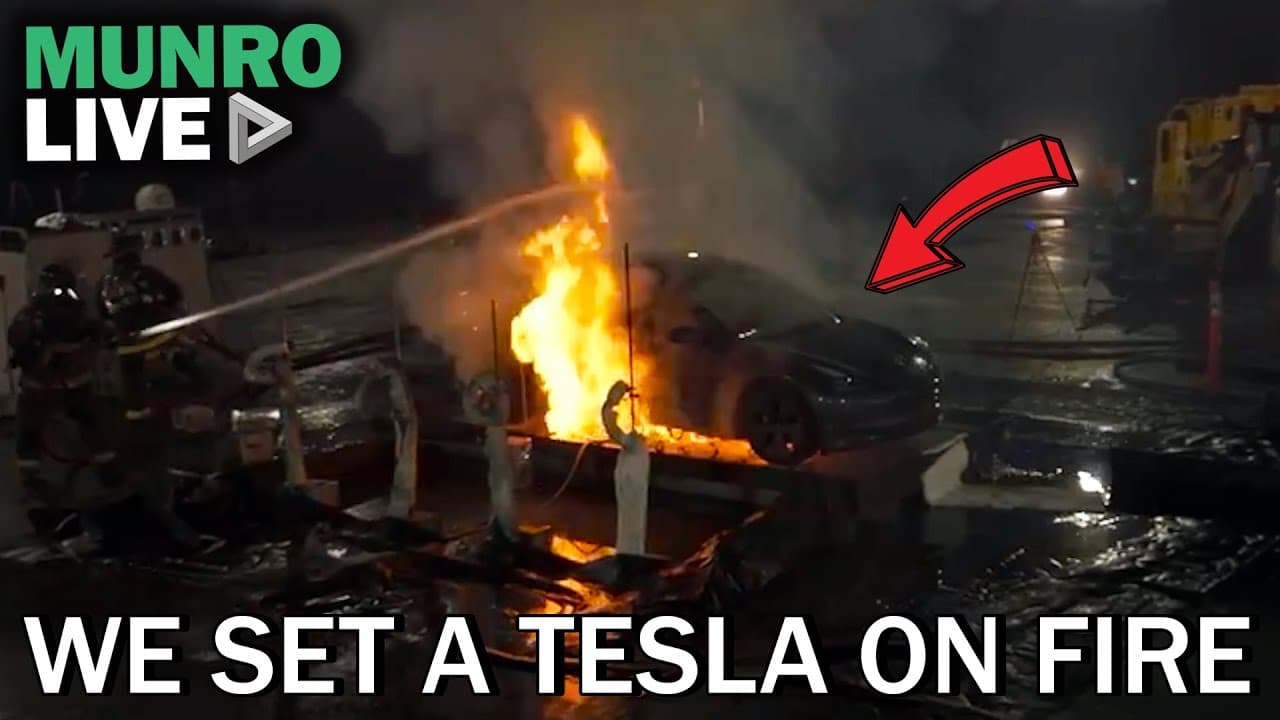
To see why an internal view matters, it helps to look at how the same question gets answered at full vehicle scale. In a Munro Live video shot at UL's Fire Safety Research Institute, a research engineer walked through the setup for a controlled burn of a 2021 Tesla Model 3 — one test in a three-year programme comparing how petrol and electric vehicles burn, and then how they can be suppressed.
The instrumentation is formidable and entirely external. The car sits in a catch pan on scales, so mass loss gives fire size. The pan also captures firefighting runoff for analysis, because the fire service is caught between letting a pack burn out and worrying about what ends up in the water. Sensor stands along the flanks measure thermal exposure to judge ignition risk to neighbouring vehicles. Stands behind the car sample particulates, volatile organics and specific carcinogenic compounds, because occupational exposure is now a live concern in firefighting hygiene. A propane-air burner — described in the video as a turkey fryer on steroids — heats one region of the pack until cells let go, with pressure and temperature sensors inside the pack signalling the moment runaway begins.
All of that tells you what a burning EV does to a car park and to the people standing near it. None of it tells you why the third cell went before the second one, or whether a vent path opened where the designer intended.
Worth keeping in proportion
The tooling is arriving against a background where EV fires are already rare. In a survey of the available data, Jordan Giesige of The Limiting Factor pulled three independent figures: the Swedish Civil Contingencies Agency put petrol and diesel cars at 20 times more likely to catch fire than EVs; Australia's EV FireSafe found a factor of 80 across all countries; Tesla's own reporting claims a factor of eight. Giesige notes the irony that Tesla's number is the most conservative of the three, and argues that is partly because Tesla counts fires per billion miles rather than per vehicle on the road, and includes events such as arson and structure fires that have nothing to do with the car.
He also makes the physical point that gets lost in headlines. A lithium-ion fire burns far hotter than a petrol fire, but the energy is divided across hundreds or thousands of steel-jacketed cells separated by resistant barriers inside a resistant housing, so it releases slowly. Higher core temperature, lower peak heat release rate.
Which is precisely the mechanism a 1,000 frame-per-second X-ray is aimed at. Propagation barriers, vent geometry and cell spacing are all bets about what happens in the first few hundred milliseconds of a failure. Engineers have tested those bets using post-test evidence, indirect sensors, simulations and high-speed synchrotron studies; Fraunhofer and PowerCo are now packaging a full-cell view for routine industrial work. Getting the camera inside the can will not overturn the fire statistics. It should make the safety margin cheaper to prove — and that, for a company planning up to 200 GWh a year across Salzgitter, Valencia and St Thomas, is the number that counts.
- https://www.electrive.com/2026/08/13/fraunhofers-x-ray-system-reveals-the-inner-workings-of-battery-cells/
- https://www.automotivetestingtechnologyinternational.com/news/battery-powertrain-testing/high-speed-x-ray-technology-exposes-hidden-battery-cell-behavior.html
- https://www.iaa-mobility.com/en/newsroom/news/future-technology/fraunhofer-powerco-xray-technology-battery-cells
- https://www.youtube.com/watch?v=0KYPuBEenos
- https://www.youtube.com/watch?v=kOz0ewP5fdM
- https://www.youtube.com/watch?v=ERwGDtHUcyE
- https://www.emi.fraunhofer.de/en/news/news-press/X-raying-batteries-under-load.html
- https://www.nature.com/articles/ncomms7924