Asahi Kasei found 10% more battery energy hiding in the first charge
A lithium-carbonate pre-doping method recovers capacity that silicon-rich cells normally lose on the first charge, without claiming to cure silicon swelling.
By EV News Desk
The most expensive trip an electric-car battery may take is the one that never moves the car. During a silicon-rich cell's first charge, some of its lithium is consumed building a protective layer on the anode. That lithium does not come back. Cell makers can compensate by loading more cathode material, but the remedy adds mass and cost before the pack reaches a vehicle.
Asahi Kasei said on 20 August that it has found a less cumbersome way to pay that chemical bill. Its new pre-doping method places inexpensive lithium carbonate in the cathode, then uses special electrolyte additives to make the compound release lithium during the initial charge. In an internal test, an NMC cell with an anode made from 90% graphite and 10% silicon monoxide delivered 10% higher energy density.
That is a substantial result from what sounds like a recipe adjustment. It is also a company result, not independent validation, and Asahi Kasei is still inviting customers into proof-of-concept evaluations. The distinction matters: this is a plausible fix for silicon's first-cycle loss, not evidence that every stubborn problem with silicon anodes has disappeared.
The lithium that gets stranded
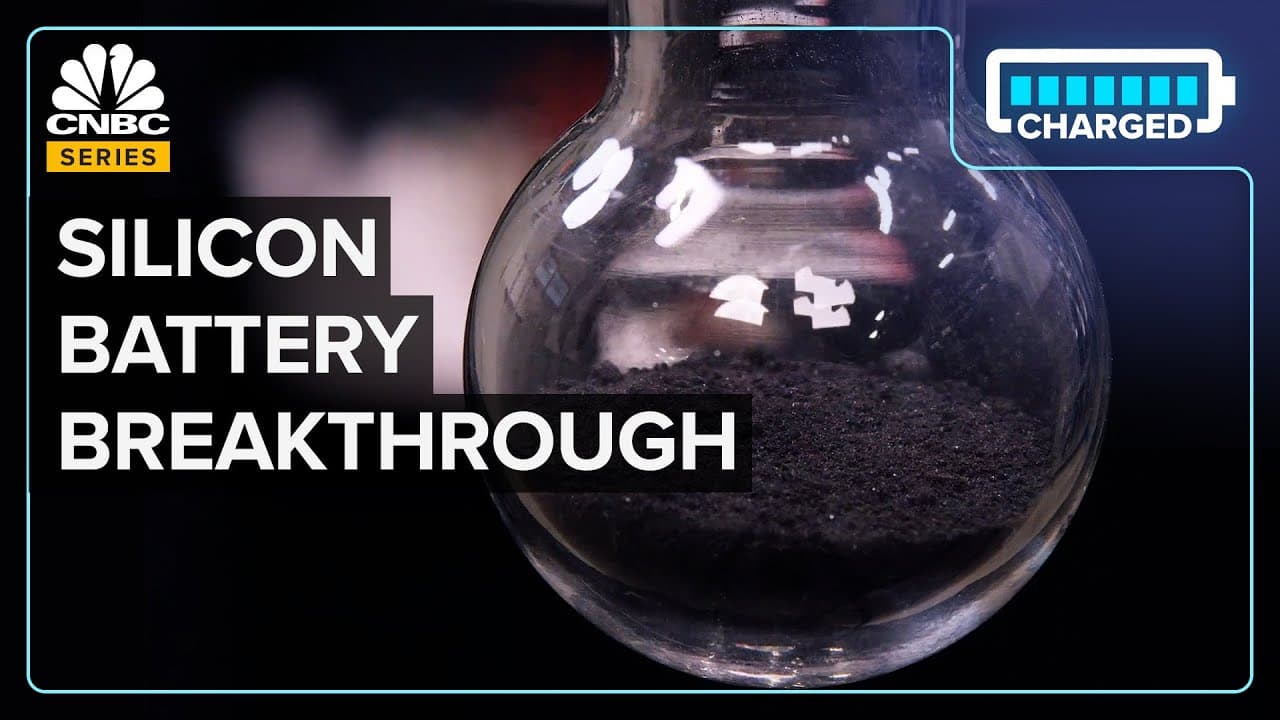
Silicon attracts battery engineers because it can hold far more lithium by mass than graphite. A Watt Up Science explainer puts graphite's theoretical capacity at 372 mAh per gram and silicon's at roughly 4,200 mAh per gram. CNBC's 2023 report on silicon-anode developers makes the atomic contrast vivid: graphite needs six carbon atoms to store one lithium atom, while one silicon atom can hold four.
The first charge exposes the catch. Electrolyte decomposes at the anode surface and forms the solid-electrolyte interphase, or SEI. The layer is necessary because it passivates the surface, but forming it consumes active lithium. A 2026 review in Carbon Neutralization reports that silicon-carbon anodes without pre-lithiation struggle to exceed 90% initial Coulombic efficiency. In plain terms, more than one-tenth of the lithium moved on the first charge may not be available on the first discharge.
Asahi Kasei's approach moves the spare supply to the positive electrode. Lithium carbonate is attractive because it is established and relatively cheap, but normally decomposes at a voltage well above a conventional cell's operating window. The electrolyte additives lower that practical barrier, allowing the carbonate to act as a sacrificial source at ordinary cell voltage. The company says existing lines would not require significant modification.
A licence, not a new cell line
Factory compatibility may be the more important claim. Pre-lithiation is not new: researchers have tried lithium-metal contact, powders, solution treatments, vapor deposition and additives at different points in production. The academic review identifies recurring obstacles including non-uniform lithium distribution, control of the pre-lithiation dose and compatibility with mass-production processes.
A Munro Live interview at the 2025 Detroit Battery Show offers a useful commercial comparison. Amprius president Tom Stepien said the company's second-generation silicon-anode cells could run through standard mixing, coating, calendering and slitting equipment, with changes to the recipe, electrolyte and binder. His point was that performance is only half the scale-up problem; a chemistry that can enter underused conventional factories has a much shorter path to volume.
Asahi Kasei is aiming for that same path from a different direction. Rather than sell a complete cell, it plans to license the pre-doping technology. Its published 10% gain came from a modest 10% silicon-monoxide blend, a composition closer to industry's incremental adoption of silicon than the dramatic all-silicon concepts that dominate battery headlines.
Inventory fixed, swelling remains
Pre-doping cannot repeal silicon's mechanics. The Watt Up Science explainer describes silicon expanding to about three times its original volume during charging. Repeated swelling can fracture particles, break electrical contact and rupture the SEI. Each fresh surface then consumes more electrolyte and lithium as another interface layer forms. CNBC's reporting similarly found that commercial developers rely on nanostructures or carbon scaffolds to keep silicon from cracking.
The 2026 review reaches the same dividing line. Pre-lithiation can raise initial efficiency, improve usable energy and sometimes support a more stable SEI, but uniformity, process control and long-term structural degradation remain active engineering problems. Asahi Kasei says its method also improved cycle life, yet its announcement does not publish the cell format, baseline energy density, cycle count, retention curve or test temperature needed to judge that claim.
For EV buyers, the 10% figure is not a promise of 10% more range in the next model year. Pack overhead, buffers, thermal hardware and vehicle efficiency stand between a cell result and road range. What the result does show is where near-term battery progress may come from: not a chemistry swap, but recovering material already inside the cell. If customer trials reproduce the gain at automotive scale, the first charge could stop being silicon's first large write-off.