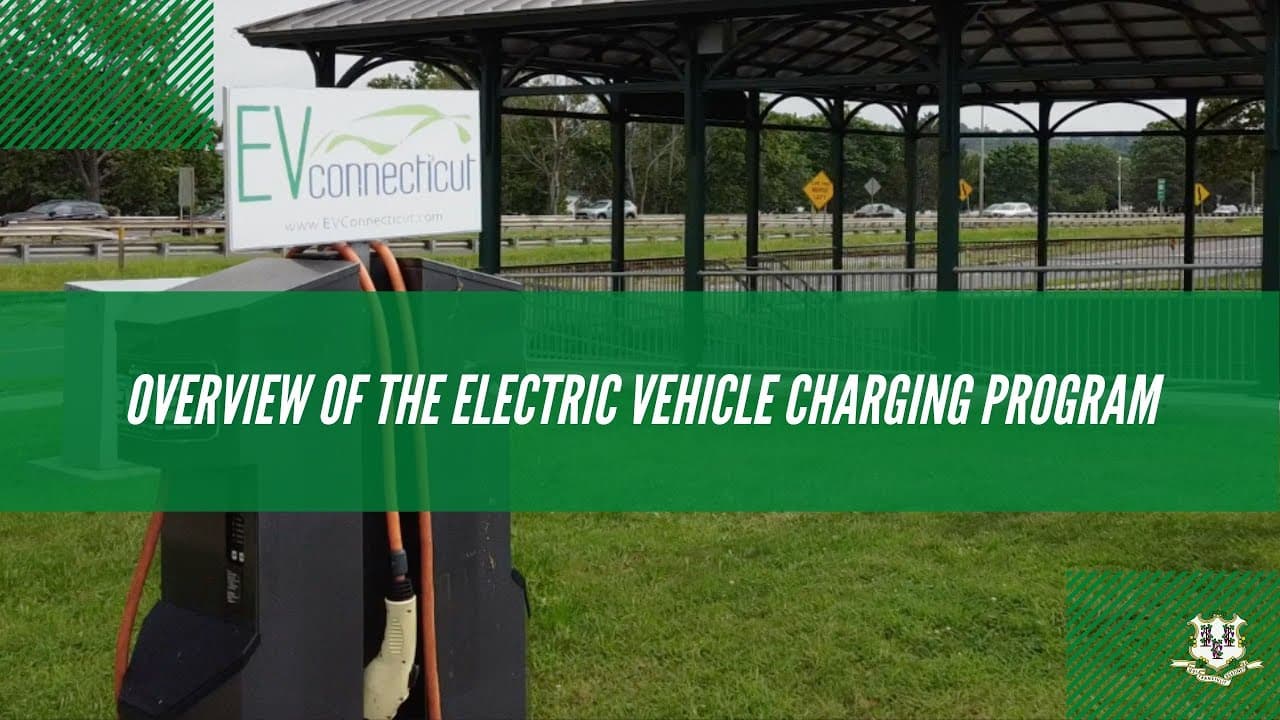
Connecticut wants public EV chargers to become a statewide grid resource
A 1,000-port pilot found that brief, rewarded charging pauses could cut peak demand without requiring compatible vehicle telematics.
By EV News Desk
Public EV chargers usually enter the grid conversation as a problem to solve. Connecticut has just advanced a different idea: treat them as a power demand that can briefly step aside when the grid is under strain, then pay the driver for the inconvenience.
The state's Public Utilities Regulatory Authority has invited AmpUp and Connecticut's electric utilities to develop a statewide version of Adapt & Earn, a managed-charging system tested at workplaces, apartment buildings, train stations, fleets and campuses. The July 1, 2026, decision does not switch on a finished statewide program. It opens the design phase, an important distinction behind AmpUp's more triumphant announcement that Connecticut had selected the project to scale.
The charger, not the car, gets the signal
Most managed-charging schemes begin in a private garage. A utility or aggregator connects to a driver's compatible car or home charger and slows charging during a peak event. Connecticut's own residential program followed that model when it launched in 2022. In a PURA explainer that year, Stefanie Keohane, supervisor of the authority's clean and affordable energy unit, described summer events between 3pm and 9pm, generally lasting two to three hours, with drivers retaining the ability to opt out.
That arrangement becomes awkward at a shared charger. The utility customer may be a landlord, employer or parking operator, while the person who needs energy is a visitor. Vehicle telematics also create a patchwork of eligible makes and models.
Adapt & Earn moves the control and reward into the charging-network platform. During a grid event, a driver can allow a short pause and receive credit in the AmpUp app. No compatible-car list or additional box is required. That is the genuinely new part of the Connecticut trial: it tests whether a public charging session can behave like flexible demand without pretending the driver owns the meter.
A heatwave supplied the difficult exam
AmpUp says the 18-month pilot with Eversource enrolled about 1,000 ports at roughly 200 sites across eight commercial customer segments. During a regional heatwave, the company says it shifted charging away from peak hours while wholesale electricity prices climbed by more than 3,600 percent. It put the cost of that relief at roughly one-third of the peak supply displaced.
Those are company-reported figures. AmpUp says they also appear in the program's independent evaluation and in PURA's decision. The state's Innovative Energy Solutions site independently confirms a $1.695 million award and describes the project as a platform for station owners to balance and optimize charging load.
The participation results matter just as much as the grid math. AmpUp reports that 91 percent of participating drivers experienced no inconvenience, 87 percent found opting in or out simple, and 83 percent would take part again. Multifamily sites recorded a 33 percent driver participation rate. Every site host remained enrolled. If those results survive a larger rollout, public charging may be easier to flex than utilities assumed.
Not a licence to strand drivers
Managed charging is not bidirectional charging. These cars do not send electricity back to the grid. The software simply reduces or pauses demand, often for long enough to avoid buying the most expensive power or overloading a local asset. It is less glamorous than turning every EV into a battery plant, but it works with the chargers and vehicles already in service.
That distinction surfaced in the source videos as well. PURA's broader program overview set separate rules for homes, workplaces, public destinations and fast chargers, while its residential explainer stressed advance notice and a driver's right to override an event. A recent grid-readiness webinar from Codibly and OpConnect likewise treated charging equipment as a distributed energy resource, with communications between utilities and charge-point operators doing the heavy lifting.
There are risks at scale. A pause that is invisible during an eight-hour workday can be unacceptable during a short grocery stop. Drivers need to know the size of the reward before opting in, operators need minimum-charge guarantees, and utilities must avoid merely creating a rebound peak when thousands of sessions resume together. Industry reporting also points to unresolved data-sharing standards among automakers, utilities and aggregators.
Connecticut now has to turn a successful pilot into tariffs, event rules and compensation that work across two utilities and many charging operators. The clever bit is already proven in miniature: public plugs need not be passive loads. The harder test is whether a statewide program can pause the right sessions, at the right time, without making a driver regret saying yes.
- https://www.ampup.io/blog/connecticut-scales-public-managed-ev-charging
- https://ct-ies.com/ies-program-cycle-1-projects/
- https://www.utilitydive.com/news/as-ev-load-grows-utilities-use-managed-charging-to-harness-flexibility-lo/816859/
- https://saemobilus.sae.org/papers/telematics-based-managed-ev-charging-a-pilot-case-study-utility-bulk-distribution-grid-services-2025-01-8122
- https://www.youtube.com/watch?v=ryTPIqE8hrw
- https://www.youtube.com/watch?v=BtLKZLp9eIU
- https://www.youtube.com/watch?v=nA8eQguRY7A
More from the file

NY-NJ port pairs electric truck vouchers with plans for up to five charging hubs
A $45 million port programme pairs vehicle discounts with nearby charging. Fleet research shows why routes, electricity bills and winter operation will decide its value.

Oslo keeps half its cars electric with 6 kW plugs, not megawatt stalls
Nearly 49 percent of Oslo's passenger cars are battery-electric. Most of the public plugs that feed them are slow AC posts where people already park.

EVgo Is Buying Tesla Hardware, but the Map May Be the Bigger Prize
EVgo will own hundreds of Tesla V4 Superchargers that Tesla operates on its behalf. The hardware adds capacity, while Tesla navigation puts the new sites in front of millions of drivers.