The 800-volt badge is a bracket, not a number: four conditions decide whether it pays
Higher pack voltage can sharply cut fast-charging time when the charger, battery temperature and state of charge cooperate. At home, it changes nothing.
By EV News Desk
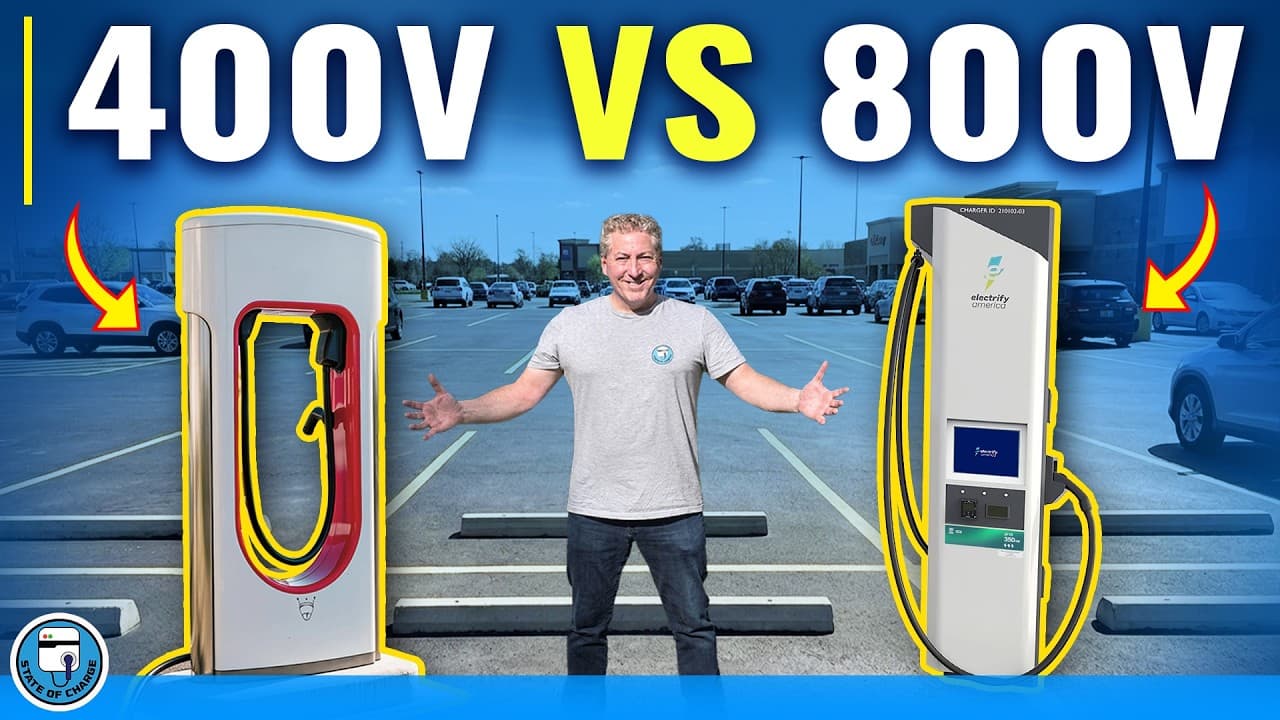
The question arrives in Tom Moloughney's inbox often enough that he made a video out of it: should I cross 400-volt electric cars off my shopping list? People about to spend fifty thousand dollars want to know they are not buying last year's electrical architecture. It is a reasonable worry, and the honest answer turns out to depend less on the car than on where its owner plugs in.
Start with the label, because it is looser than it looks. Moloughney, who runs the State of Charge channel, points out that a “400-volt” pack usually sits somewhere between 300 and 500 volts, and anything above 500 gets filed under 800 — including cars that run past 900. Corey at Battery Bound puts a number on how loose that is: the Porsche Taycan, the car that started the whole category in 2019, spends most of its life around 723 volts and only touches the mid-800s at a full charge. He quotes CATL's own material describing systems anywhere from 550 to 900 volts as belonging to the 800-volt class. It is a bracket, not a measurement.
What the extra voltage actually does
Charging power is voltage multiplied by current, so the arithmetic is not subtle. A 400-volt car drawing 300 amps takes 120 kW. An 800-volt car needs only 150 amps for the same 120 kW. Since cells will only accept so much current before they degrade, and since current is what generates heat, the higher-voltage car gets to the same power with less of everything that goes wrong.
Heat is the mechanism. More amps mean more losses in the charger, the cable, the car's own components and the pack — and then the thermal management system spends more energy pushing that heat back out, which is itself a loss. Moloughney's summary: the higher the amperage, the more of the electricity you paid for never reaches the battery. The lower-current car also gets thinner cables, smaller bus bars and lighter hardware.
On the stopwatch, he puts the average 800-volt car at under 20 minutes from 10 to 80 per cent and the average 400-volt car at 25 to 45. His example pairs the Hyundai Ioniq 5 against the Chevrolet Equinox EV — similar size, similar cargo space, similar range — and the Equinox takes close to twice as long.
Four things have to be true at once
That number is conditional, and Battery Bound lists the conditions plainly: an actual 800-volt car, a charger built to deliver it, a preconditioned battery and a low state of charge on arrival. Miss one and the brochure figure does not appear — four conditions that must coincide at the charger.
The charger condition used to be the embarrassing one. Citing Department of Energy data and analysis from Paren, Battery Bound says the United States entered this year with roughly 68,000 public DC fast-charging ports, about 10,000 of them — 15 per cent — running at 350 kW or better. That population grew 56 per cent in a year, which makes it the fastest-growing category of charger in the country and a reminder of how small it was before.
Plug an 800-volt car into one of the many 400-volt stalls and it has to boost the incoming power before the pack will take it. Hyundai and Kia manage this gracefully, but they top out around 150 kW doing it. Which produces the genuinely counterintuitive outcome: on older hardware, a plain 400-volt car can out-charge the expensive one.
The same car, two chargers
Somebody has measured this. The Studz Studios channel took a Hyundai Ioniq 5 N — one car, one battery, one night — and charged it at a 350 kW Electrify America stall and at a Tesla Supercharger, which at the time could not supply 800 volts.
At Electrify America the car peaked at 261 and 263 kW across two sessions and took on about 60 kWh in 20 minutes. At the Supercharger it settled at 126.5 kW and delivered 45.4 kWh in 25 minutes — five minutes longer for a quarter less energy. The tester's point about starting state of charge is the sharp one: he plugged in at 36 per cent rather than 13, and it made no difference, because the ceiling was the voltage, not the pack. He estimates that matching the fast session's energy at the Supercharger would take roughly ten extra minutes.
He is careful about conditions. Both fast sessions ran at night in mild weather with a warm battery, and the second still derated early because the pack got too hot. Too cold and you never reach peak; too hot and the car pulls back.
Where it stops mattering
In your driveway. Pack voltage is irrelevant to AC charging, where the onboard charger sets the rate; an 800-volt car and a 400-volt car on the same wallbox fill at the same speed overnight. Both Moloughney and Battery Bound land on this, and it is the part that reframes the shopping question. The most impressive-sounding line on the spec sheet is invisible to a home-charging commuter, which describes most owners.
What has changed is the price of finding out. Battery Bound compared window stickers on a Kia EV6 Light and a Ford Mustang Mach-E Select and found them within a hundred dollars of each other, where two years ago Kia wanted about $6,000 more. The Ford still offers more range at that trim — 300 miles to 237 — so they are not twins. But when the architecture costs nothing extra, there is no argument for avoiding it either.
Rivian ran the same numbers and went the other way, confirming 400 volts for the R2 to protect its price and accepting roughly 30 minutes from 10 to 80 per cent instead of 20. Ten minutes, a few times a year, for a cheaper car. Plenty of buyers will take that trade without ever knowing they made it.
More from the file

Waymo's Las Vegas robotaxis are queuing at public chargers, and drivers noticed
Days after Waymo opened to public riders in Las Vegas, ride-hail drivers reported waits of up to 90 minutes at an Electrify America site. Waymo says it limits its public charging.

New York hands its curbside charging buildout to a Brooklyn startup
The city picked Brooklyn's it's electric to build a curbside Level 2 network aimed first at ride-hail drivers who park on the street. Pricing has not been set yet.

IONITY's Greenwich hub brings 400 kW to the weekly shop. Will the bill fit?
A new Mr. EV visit tests the promise of IONITY's urban expansion: useful locations and powerful chargers, with price and the car itself deciding everyday value.