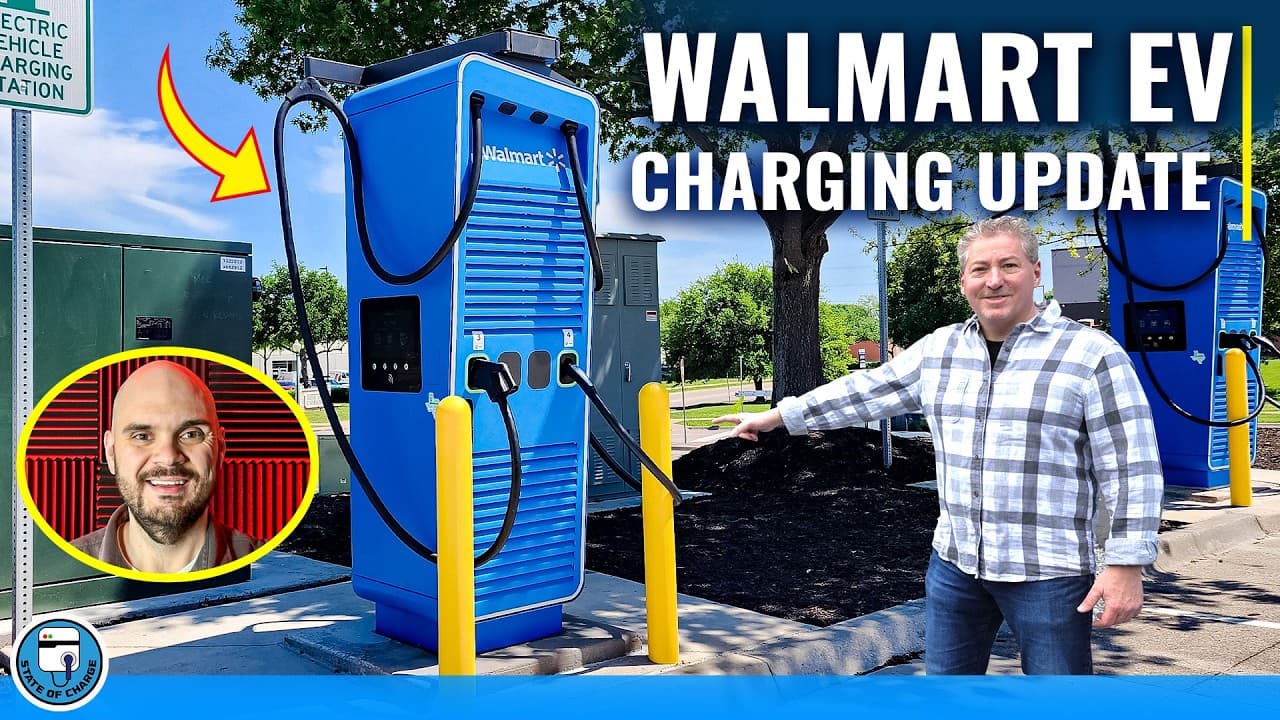
Walmart hit 100 fast-charging sites. The price still changes store to store
Walmart's in-house network passed 100 sites and 838 stalls in July, and independent tests found it both cheaper and dearer than the nearest Supercharger. The 18-cent spread between Walmart's own stores explains why.
By EV News Desk
Two EV owners plugged into a Walmart fast charger this summer and came away with opposite conclusions, and both of them were reading the price screen correctly.
Tom Moloughney of State of Charge pulled into a Walmart in New Jersey and paid 39 cents per kilowatt-hour. He then checked the Tesla Supercharger a couple of miles away in Freehold, which was running dynamic pricing and would have cost him 62 cents at that hour, roughly 60% more.
The host of The Average EV drove four and a half hours to reach the nearest Walmart site to him, in Cranberry Township, Pennsylvania, and found 51 cents on the screen. The local Supercharger was 42 cents. An Ionna site he had used in Bridgeville was on a 20-cent promotion, and even at its usual 39 cents it beat both. For a driver choosing strictly on price, he concluded, Walmart would lose that local comparison.
One hundred stores, and no national price
Walmart confirmed its 100th company-owned fast-charging site on 31 July, at the Supercenter on Jackson Creek Parkway in Monument, Colorado. Electrek reported the network now spans 20 states. State of Charge's monthly tally puts total stalls at 838, up by 226 in a single month after a record 27 site openings in July, with hardware split exactly evenly between Alpitronic HYC400 Hyperchargers and ABB A400 units.
"Reaching 100 sites is an important milestone, and our broad footprint positions us to make EV charging more accessible for communities while expanding the ways we serve our customers," said Shayne Wahlmeier, senior vice president of Walmart Energy.
What the milestone announcement does not convey is how much the price moves between one Supercenter and the next. Working through the July openings State of Charge catalogued site by site: Taylorsville, Utah opened at 41 cents. Marysville, Washington opened at 59 cents. Both are Walmart-owned, both are 400 kW, both went live in the same three weeks. That is an 18-cent spread inside a network that markets itself as a single brand.
The averages sit in the middle and hide the range. State of Charge calculates the network's mean on-peak rate at 47 cents, the Walmart+ member average at 42 cents, and the off-peak average at 30 cents, blending to an effective 37 cents. Analytics firm Paren, cited by InsideEVs, put Walmart at 43 cents on average, fourth cheapest of 17 US networks behind Ionna, Shell Recharge and Rocky Mountain Power. Tesla and Electrify America both averaged 56 cents.
The discount nobody is on a road trip for
The deepest cuts in the July list are all off-peak. San Antonio drops to 24 cents overnight. So does Warr Acres, Oklahoma. Snellville, Georgia falls to 25 cents. Rockwall, Texas and Concord, North Carolina both go to 27. Those are home-charging numbers, offered at hours when almost nobody is doing a highway stop.
That timing is the tell. Off-peak rates that aggressive are aimed squarely at drivers who do not have a home charger and treat the Supercenter lot as a weekly errand, not at road-trippers. It is also the cheapest energy Walmart can buy, so the discount costs the retailer least exactly where it wins the most loyalty.
Loren McDonald, chief analyst at Chargenomics, framed Walmart's economics bluntly to InsideEVs: "Walmart, obviously, is in the business for a very different reason." The stores already own the land, buy hardware at a scale that flattens supplier quotes, and make their real money once the driver walks inside. "The key for them obviously is getting people inside the store for 40 minutes, spending $50 or $100, not just the $22 out front."
The Electric Viking's read on the same Paren data was that a genuine price war has opened, with Walmart and Ionna undercutting Tesla and Electrify America from below because neither treats electricity as its profit centre. That is a fair description of the pressure, though the evidence so far is that Walmart is applying it unevenly, store by store, rather than as a national tariff.
Friction that money does not fix
Price is not the only variable a driver meets in the lot. The Average EV's Cranberry Township visit turned up no credit card reader, an app-only activation, and a side-mounted NACS cable that he had to drape over the hood of his Tesla. He was concerned about scratching the paint and also noted that the pricing screen disappeared once charging began.
Walmart has acknowledged both complaints. In an interview with State of Charge and The Arkansas eTraveler, the company confirmed payment terminals are coming to its dispensers and the NACS and CCS cable positions will be swapped. Adam Happel, general manager of Walmart Retail EV Charging, told Electrek: "When a customer pulls into a Walmart to charge, we want the experience to feel as reliable and effortless as the rest of their shopping trip."
Where the build goes next
State of Charge has reset its projection target to 200 sites and expects Walmart to reach it before the end of the year, with the average gap between openings down to 5.1 days. That is a tracker's projection, not a target Walmart has announced.
Scale is not the constraint. Walmart operates more than 5,200 US stores, roughly 90% of Americans live within 10 miles of one, and first-party charging has reached only about 2% of that footprint. State of Charge estimates that 7.49% of Americans now live within 10 miles of one of the charging sites.
Which means the 18-cent spread matters more than the 100-site headline. A driver deciding whether Walmart is the cheap option cannot answer the question from the brand name. They have to open the app and look at their own store.
- https://www.youtube.com/watch?v=HqDG3u1kp_g
- https://www.youtube.com/watch?v=Y44FmZqh6fs
- https://www.youtube.com/watch?v=oZZhCtlF3nI
- https://www.youtube.com/watch?v=aSzHEGBcXcI
- https://insideevs.com/news/805215/ionna-walmart-cheaper-prices/
- https://electrek.co/2026/08/21/walmarts-400-kw-ev-charging-network-just-hit-100-stores/
More from the file

Waymo's Las Vegas robotaxis are queuing at public chargers, and drivers noticed
Days after Waymo opened to public riders in Las Vegas, ride-hail drivers reported waits of up to 90 minutes at an Electrify America site. Waymo says it limits its public charging.

New York hands its curbside charging buildout to a Brooklyn startup
The city picked Brooklyn's it's electric to build a curbside Level 2 network aimed first at ride-hail drivers who park on the street. Pricing has not been set yet.

IONITY's Greenwich hub brings 400 kW to the weekly shop. Will the bill fit?
A new Mr. EV visit tests the promise of IONITY's urban expansion: useful locations and powerful chargers, with price and the car itself deciding everyday value.