Luxury EVs got cheap. The bills that come with them did not
Five-year-old electric cars have shed 57.2% of their value on average, and premium models lead the fall. Three buying accounts converge on the same conclusion: the discount is the least useful number in the listing.
By EV News Desk
A 2019 Audi e-tron sold for north of $70,000 with options. You can buy one now for the mid-$20,000s. An early BMW iX approached $90,000 new; the cheapest listings start in the low $30,000s. In Britain, a Jaguar I-Pace that cost about £70,000 is barely over £10,000. These are not typos, and they are not distress sales. They are what happens when a segment built on early-adopter pricing meets a used market that never agreed to those prices in the first place.
iSeeCars put numbers on it in April, after analysing more than 950,000 five-year-old vehicles sold between March 2025 and February 2026. Battery-electric cars gave up an average of 57.2% of their value over five years. EVs and luxury models accounted for twenty-four of the twenty-five heaviest losers. A Tesla Model S shed 62.0% — $58,907 in cash terms. "Electric vehicles consistently cost more than the equivalent gasoline or hybrid model," executive analyst Karl Brauer said. "That high upfront cost comes back to haunt electric cars on the used market, where buyers aren't willing to pay the premium."
Which is excellent news, if you are the second owner. The complication is that only one number on the car actually fell.
What the discount doesn't touch
The buying-guide channel NextGear made the point more crisply than most in a July video on collapsing luxury EV prices: depreciation changes what a car costs to buy, but it does not change what that car costs to repair. The e-tron's tyres, suspension components, body panels and insurance premiums all still belong to a large, heavy, fast Audi. The iX's air suspension and 22-inch wheels do not know that the car is now worth a third of its sticker. Insurance underwriters price the repair, not the resale.
That is why the advice NextGear lands on — buy the condition and the warranty, not the discount — is less bland than it sounds. It is a claim about which part of a used luxury EV is genuinely worth money.
The warranty clock is the asset
The sharpest version of that argument came from the British car journalist behind the channel The Miles Driven, who goes by Miles and who ran the numbers on depreciated premium EVs against cheap new ones in mid-August. His warning is mechanical rather than philosophical, and it concerns mileage caps.
Take a Polestar 2. Its battery is covered for eight years or 100,000 miles, whichever falls first, against dropping below 70% of original capacity. Buy one showing 105,000 miles and its age is irrelevant — there is no battery warranty left to inherit, at any price. Buy the same car at 50,000 miles and five years old and you have roughly three years of coverage ahead of you, provided you do not burn through the mileage. High-mileage examples cluster in the same £15,000-to-£18,000 bracket as the lower-mileage ones, which is precisely the trap: the cheapest listing and the second-cheapest listing can differ by an entire warranty.
He adds a second filter that gets overlooked. Given a choice between a discounted Mercedes EQC and a discounted Audi e-tron GT at similar money, he leans to the Audi because Audi still builds it. Discontinued models get exported or broken for parts earlier in life, and parts availability outlives the badge.
One owner's actual ledger
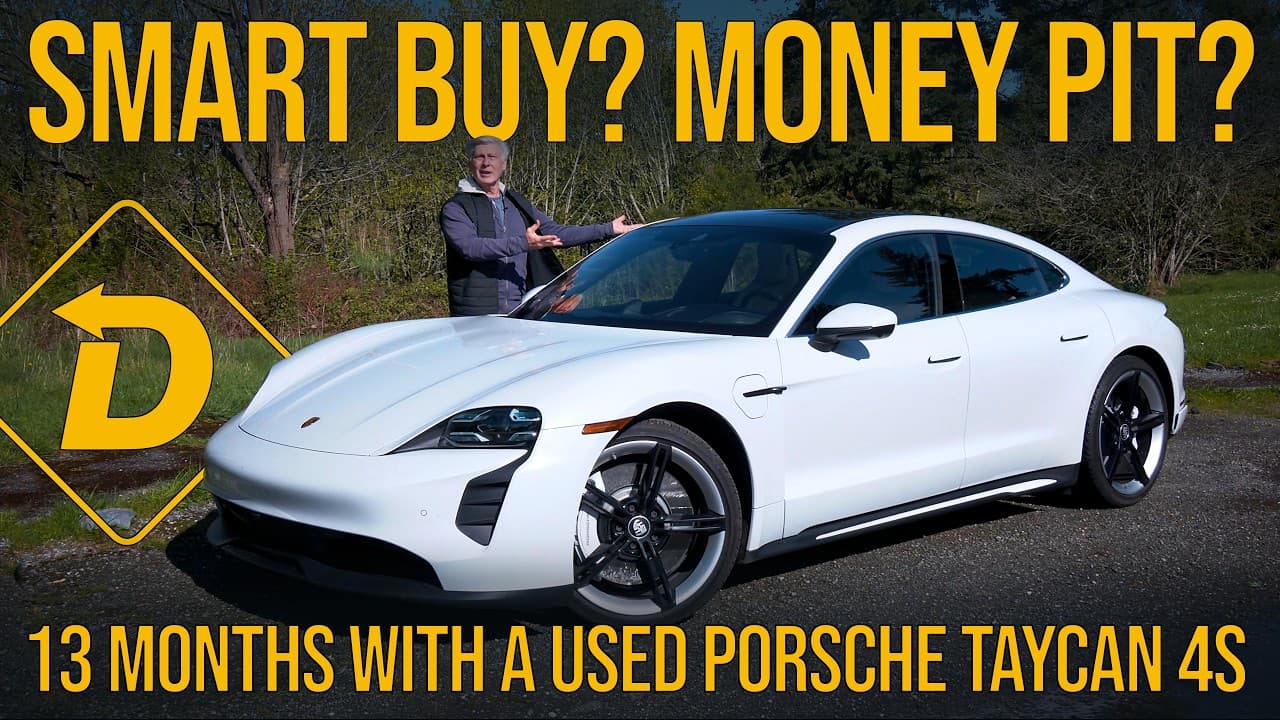
Set against the horror stories, it is worth reading a real four-and-a-half-year record. Tom Voelk of Driven Car Reviews bought a certified pre-owned 2021 Porsche Taycan 4S — $163,000 new, $74,000 to him — and published a thirteen-month accounting in April. The CPO programme added two years to the remaining factory cover, giving him thirty months.
In that time, at 38,700 miles, he had exactly one fault: the Taycan’s known "red ring of death" warning, cleared by locking the car for five minutes and then permanently by a software update. Recalls on the front brake lines, HVAC and mobile charge cord had all been completed before he took delivery. The pack, on an EPA-rated 227-mile car, still returned around 230 miles in warm weather — better than its rating after four years. A cold-weather run to Whistler in low-20s Fahrenheit temperatures, uphill, cut that to about 170. A manual pack rebalance recovered fifteen indicated miles.
His running costs are the part that does not travel. Charging overnight in Washington at nine cents per kilowatt-hour, 200 miles costs him $7.65, against roughly $60 of premium petrol for the Panamera 4S he might otherwise have bought. On a DC fast charger it would be about $42 — still cheaper. He has also cancelled the $30-a-month Porsche Connect subscription and declined an extended warranty, reasoning that the high-voltage pack still has more than four years of coverage and that wear items such as brakes and the expensive 12-volt battery would not be covered anyway.
"I will never argue that a Porsche is a budget proposition," Voelk says. He also thinks he could sell the car for what he paid.
Four calls before viewing the car
The useful shortlist is brutally practical: check the remaining battery warranty by both age and mileage, obtain an insurance quote, price the fitted tyres and ask about parts support. Do that before travelling to see the car. A five-figure discount can pay for plenty of electricity; it looks less impressive beside one uninsured repair.
More from the file

A 234,000-mile Lightning gets a used battery. The repair matters more than the mileage
Out of Spec Renew replaces a high-mileage Lightning battery after a module fault. Ford warranty terms and fleet data explain what this repair can tell owners.

Audi Offers Up to $10,000 Off Lease Buyouts for Its EVs
A 1 September dealer bulletin cuts thousands from contractual buyout prices for Audi EV lessees and gives dealers $500 per completed deal. The discount is real, but lessees still need to compare it with market value.

EVs cost 33% less to drive in Europe, unless you have nowhere to park
The ICCT's EV Transition Check 2026 has a headline number and a footnote. Drivers who charge at home save a third on energy. Drivers who rely entirely on public chargers save five per cent.