Truck Charging's Real Bottleneck Is the Utility Queue, Not the Charger
America's largest new electric truck hub secured 9 MW. A Chinese depot north of Chengdu has 51 MW of charging equipment installed. The comparison shows why interconnection, distributed architecture and load scheduling now set the pace of freight electrification.
By EV News Desk
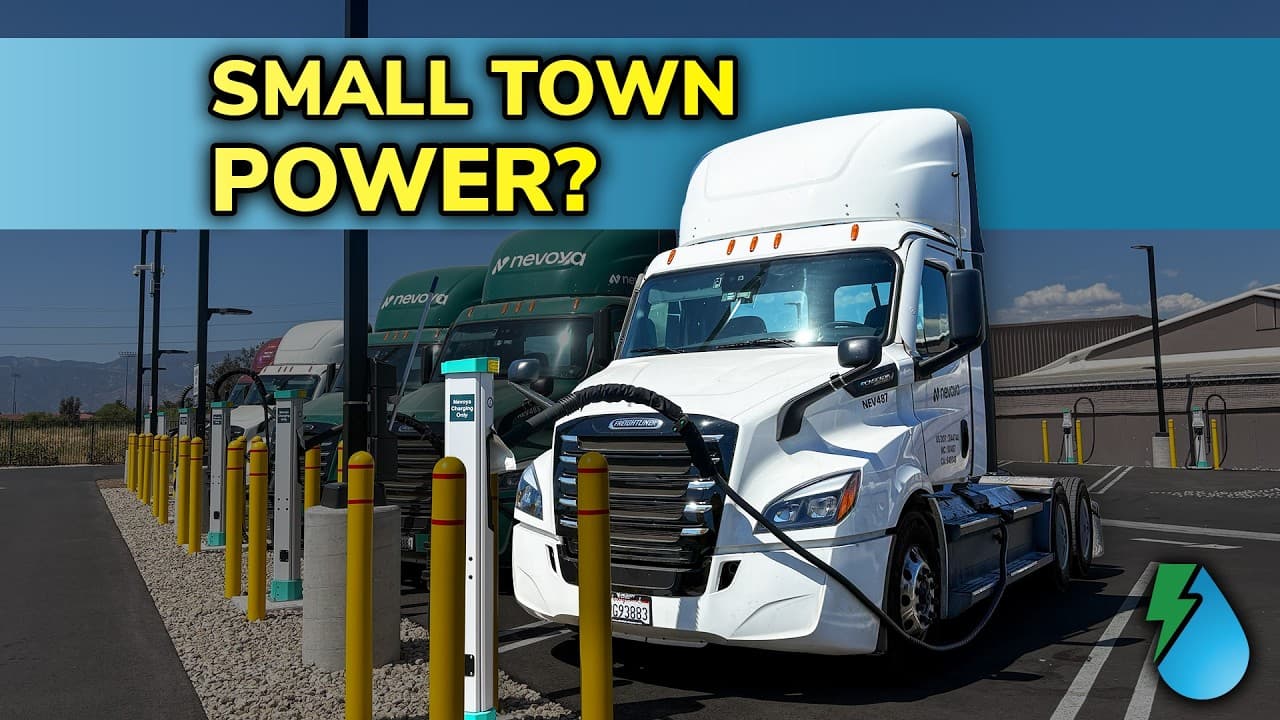
Nine megawatts. That is the number EV Realty put behind 76 charging ports on Mill Street in San Bernardino, and it is enough to make the site one of the largest commercial electric truck hubs in the United States. Roughly 11,000 kilometres away, on a plateau north of Chengdu, a single Chinese truck depot has 51 megawatts of charging equipment installed across 108 charging bays, with a second phase planned to lift that figure towards 100 MW.
Both sites expose the same constraint: charging hardware can be installed faster than a site can secure the grid capacity to use it.
The scarce commodity is the interconnection, not the charger
EV Realty's chief commercial officer Suncheth Bhat, a former PG&E hand, was candid with Commercial Carrier Journal about how the San Bernardino hub happened so quickly — ground broken in September, open in April. The company did not go looking for a site and then ask for power. It went looking for power and then found a site.
"This site we found with some of our proprietary software that analyzes grid information, truck density information, truck traffic information and land use conditions," Bhat said. The parcel sits a quarter-mile from Interstate 215 with roughly 3,000 heavy trucks domiciled nearby and 18,000 passing daily — but the deciding factor was that Southern California Edison happened to have spare capacity underneath it.
Bhat gave Edison credit for something unglamorous: publishing its grid data. "They have a lot of data that they make public about their grid and where there is power," he said. "Not all utilities do that." Because the hub was sited into an existing pocket of capacity, EV Realty got the full nine megawatts it asked for quickly, rather than joining the queue behind a substation upgrade. That siting decision avoided waiting for a substation upgrade, although the same shortcut depends on finding spare capacity before another project claims it.
Stretching a small feed across a lot of plugs
Once the interconnection is fixed, the engineering question inverts: how do you serve the most vehicles from the least capacity? Kempower senior solutions engineer Adam Wagner laid out the arithmetic to Out of Spec Reviews at a demonstration site in Nödinge, Sweden.
"You have to pay to interconnect your chargers to the grid," Wagner said. "The grid's going to charge you based on how much capacity you put on there. So you want to keep that number small, but you also want to serve a lot of spots." Standalone chargers force an operator to guarantee full rated power to every plug, which sizes the connection — and the demand charges — for a peak that almost never arrives. A distributed architecture, where power cabinets feed a pool of dispensers, lets the site oversubscribe. Wagner reckons the saving runs 10 to 20 per cent on overall grid requirements.
His supporting statistic is the one worth remembering: Kempower's own analysis puts the global average charging session at around 80 kW. "People want these really sexy 400, 500 kilowatt chargers," Wagner said. "Yes, they are going to be needed here for certain applications, but they're not needed for everything by any means."
San Bernardino runs exactly that way. Power arrives in 600 kW Kempower blocks, each feeding six dispensers, with software throttling between them. Bhat described ingesting a customer's schedule so that a truck with a tight turnaround gets priority while one with a long dwell trickles — then reversing the allocation once the first has gone. Seventy-two of the 76 stalls are dedicated pull-in bays at up to 400 kW; four are pull-through; two megawatt-standard chargers rated to 1.2 MW sit ready for MCS-equipped trucks including the Tesla Semi.
The fleet side is a scheduling problem too
Nevoya, an all-electric carrier running Freightliner eCascadias out of the hub daily, treats charging time as a first-order cost variable rather than a logistics afterthought. Co-founder and chief executive Sami Khan put the failure mode bluntly: "If you charge at the wrong time or the wrong location, all of a sudden what would have been a profitable route is unprofitable."
In practice that means Nevoya's software choreographs shift changes around tariff peaks — pulling drivers in before the late-afternoon window, unplugging, and sending trucks out on a second shift. Every fleet doing this is, incidentally, doing grid load management, whether or not anyone bills it as such.
What 51 megawatts looks like
The site 150 km north of Chengdu, visited in May by e-mobility consultant Syed Haseeb Hassan on a Huawei-arranged tour, shows the scale of hardware China is installing. Hassan counted the bays himself, at walking pace and then by car: 108 charging spots, each with two 600 kW dispensers, giving 216 plugs, plus 18 Huawei 1.44 MW units — 72 power cabinets at 720 kW apiece for 51 MW installed. Transformers rated 1,600 kVA. One megawatt of rooftop solar and two 215 kWh battery cabinets, which at those ratings are trimming peaks rather than powering anything. Hassan said operators put traffic at around 700 trucks a day and reported a one-day high of 300,000 kWh; phase two is planned to add 33 more megawatt units. Those operating figures were presented during the tour and have not been independently audited.
The trucks are middle-mile, 200 to 300 km out and back, carrying 281 to 601 kWh packs. Nothing about that duty cycle is exotic. What is different is that the depot sits beside substantial transmission infrastructure and, according to the tour, is being built towards 100 MW of charger capacity.
Kempower's European tally underlines how early the West still is: a public MCS site in each Nordic country, the largest being DP World's London Gateway with 12 MCS and eight CCS chargers totalling around 11 MW — and that one is charging reach stackers, not trucks. American megawatt charging exists in twos and fours.
Which makes the honest read of San Bernardino less triumphant than it first sounds. It is a well-engineered answer to a constraint nobody has removed. The chargers are ready, the trucks are arriving, and the queue that matters now forms at the utility.
- https://www.youtube.com/watch?v=_3feyIONzjw
- https://www.youtube.com/watch?v=oJdm4y80u-g
- https://www.youtube.com/watch?v=FI-_PQy65LI
- https://electrek.co/2026/04/09/76-chargers-9-mw-a-huge-ev-truck-charging-hub-opens-where-us-freight-actually-runs/
- https://www.globenewswire.com/news-release/2026/04/09/3271033/0/en/ev-realty-opens-major-truck-charging-hub-in-california-s-inland-empire-with-76-ports-and-9-mw-of-capacity.html
More from the file

Waymo's Las Vegas robotaxis are queuing at public chargers, and drivers noticed
Days after Waymo opened to public riders in Las Vegas, ride-hail drivers reported waits of up to 90 minutes at an Electrify America site. Waymo says it limits its public charging.

New York hands its curbside charging buildout to a Brooklyn startup
The city picked Brooklyn's it's electric to build a curbside Level 2 network aimed first at ride-hail drivers who park on the street. Pricing has not been set yet.

IONITY's Greenwich hub brings 400 kW to the weekly shop. Will the bill fit?
A new Mr. EV visit tests the promise of IONITY's urban expansion: useful locations and powerful chargers, with price and the car itself deciding everyday value.