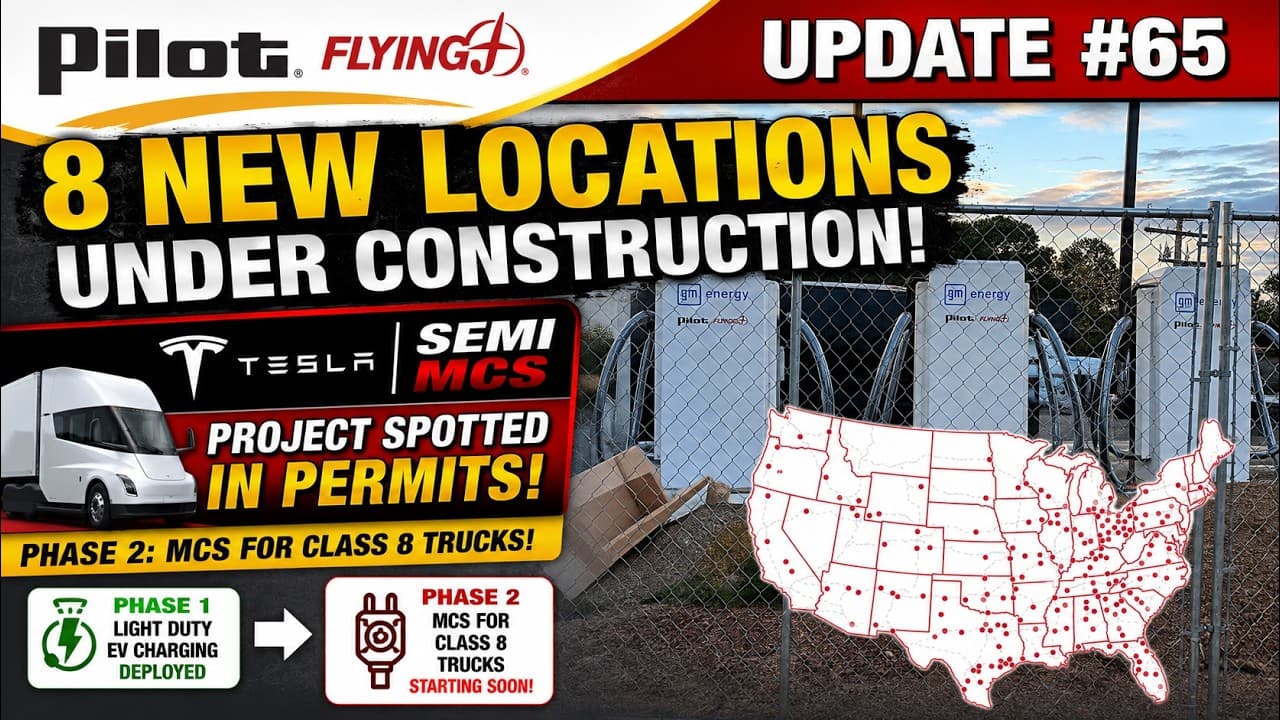
Tesla's public Megacharger rollout is hiding in permit filings
Tesla has two confirmed customer-facing Megachargers near the Los Angeles ports and 64 more locations on its map. Pilot's rollout remains difficult to track.
By EV News Desk
If you want to know where Tesla is going to put its megawatt truck chargers, the fastest route right now is not a press release. It is county permitting records.
The Network Architect Channel, which has spent more than a year tracking every Pilot Flying J charging site into a spreadsheet, opened its latest update on 30 August with an admission that the tracking has broken. The Alternative Fuels Data Center database it relies on — normally so dependable that a station appears the day after it opens, “without exception” — has gone quiet on both Pilot and EVgo entries. The channel's progress graph, which had climbed steadily past 300 sites, is now a flat line, while its host says he can still see new construction sites in the field.
So he went looking elsewhere, downloading Pilot's full location list and filtering the amenities column for EV charging. It matched what he already had. A dozen city names differed. Nothing new.
What did turn up was in permit filings, surfaced by the Bennett EV Infrastructure Report: the Tesla Semi megawatt charging build is proceeding, and the footprint is becoming legible. One site sits near Jacksonville, Florida, close to where Interstate 10 meets the 295 beltway. Texas has a cluster, roughly half of it at Pilot locations.
Where the trucks will run first
The channel's read of that geography is a Texas Triangle burn-in first — a proof-of-concept loop between the state's major metros — before expansion outward along I-10 and I-40, with I-5 built out to some extent. The reasoning is freight, not politics: the ports of Los Angeles and Long Beach and the Inland Empire behind them form one of the heaviest Class 8 ingress points in the country.
That squares with the map Tesla published in February, when it dropped 64 Megacharger locations across 15 states onto its Find Us page. Texas led with 19 planned sites, California with 17. Florida, Georgia, Illinois and Washington took four each. Add the two sites already running at the time — Giga Nevada in Sparks and a dedicated facility in Carson, California, near the Port of Long Beach — and the network on paper reached 66 locations.
Paper has since become concrete, slowly. Tesla opened its first customer-facing Megacharger in Ontario, California, in March, at the I-10 and I-15 interchange in the Inland Empire, though that site was limited to 750 kW. Vernon, in the industrial sprawl southeast of downtown Los Angeles, followed in August with six stalls rated at up to 1.2 MW. Those are the two customer-facing sites confirmed by the supplied reporting, both near the same port complex.
Pilot's half of the deal
Pilot agreed in January to host Tesla Semi chargers at travel centres across California, Georgia, Nevada, New Mexico and Texas, with four to eight stalls per site at up to 1.2 MW each. Construction was to begin in the first half of this year and the first stations were expected to open by summer. As August ends, none of the supplied sources confirms that a Pilot-hosted site has opened; the customer-facing openings they identify are Tesla's own.
“Helping to shape the future of energy is a strategic pillar in meeting the needs of our guests and the North American transportation industry,” Shannon Sturgill, Pilot's senior vice president for alternative fuels, said when the deal was announced. “Heavy-duty charging is yet another extension of our exploration into alternative fuel offerings, and we're happy to partner with a leader in the space that provides turnkey solutions and deploys them quickly.”
Sturgill also appeared in a Pilot video posted to social media this month, making the case for the light-duty network the company already has. “Over the road, there's not a distinct over-the-road network that's been built out like ours,” she said. “Our locations have canopies, which again seems very basic, but it's actually a really differentiator for us for weather.”
The Network Architect's own site tour that day was a new six-stall canopy at East St. Louis, sitting where several interstates converge to cross the Mississippi. He noted, with some enthusiasm, that Pilot stations hand out a barcode for a free fountain drink, on the reasonable theory that you are going to be standing there for twenty minutes anyway.
Why the timing matters
Tesla built the first version of this network for its own logistics. The Semi rolled off a high-volume line at a new factory near Sparks, Nevada in late April, which changes the arithmetic: chargers that used to serve a pilot fleet now have to serve customers who bought trucks and expect to run them. A Megacharger can put back up to 60 per cent of the Semi's range in roughly half an hour, which is the shape of a mandated driver rest break rather than an overnight depot stop — the whole argument for electric long-haul depends on that number holding at scale.
What is missing is the public accounting. A year ago, anyone could watch this build-out happen through a federal database that updated daily. Now the most reliable early signal that a megawatt charger is coming to your interstate is a permit application filed with a county planning office, found by someone who went looking. That is a strange way to track national freight infrastructure, and it is currently the best one available.
- https://www.youtube.com/watch?v=YeepPuLpZ3s
- https://electrek.co/2026/02/24/tesla-megacharger-64-locations-semi-truck-charging-network-map/
- https://electrek.co/2026/03/08/tesla-opens-first-megacharger-ontario-california-semi-customers/
- https://evwire.com/p/tesla-second-public-megacharger-vernon-california
- https://cleantechnica.com/2026/02/01/tesla-semi-chargers-planned-for-pilot-travel-centers/
More from the file

Waymo's Las Vegas robotaxis are queuing at public chargers, and drivers noticed
Days after Waymo opened to public riders in Las Vegas, ride-hail drivers reported waits of up to 90 minutes at an Electrify America site. Waymo says it limits its public charging.

New York hands its curbside charging buildout to a Brooklyn startup
The city picked Brooklyn's it's electric to build a curbside Level 2 network aimed first at ride-hail drivers who park on the street. Pricing has not been set yet.

IONITY's Greenwich hub brings 400 kW to the weekly shop. Will the bill fit?
A new Mr. EV visit tests the promise of IONITY's urban expansion: useful locations and powerful chargers, with price and the car itself deciding everyday value.