EV battery packs are getting denser, but the repair bill is hiding in the glue
Structural battery integration can cut parts and add stiffness, yet fresh research and three very different teardowns show why pack density and repairability are pulling apart.
The most impressive component in a modern EV battery pack may be the empty space that engineers have eliminated. Module walls disappear, cooling plates do two jobs, and the pack itself becomes part of the car's structure. That is good engineering at the factory gate. At a repair bench or recycling line, the same pack can look like a sealed puzzle assembled with adhesive.
A June 2026 perspective in Nature Reviews Clean Technology puts numbers around that bargain. Its authors report that integrated designs have pushed system-level volumetric efficiency above 70% and energy density towards 255 Wh/kg for nickel-rich chemistries. They also warn that local faults are more likely to trigger whole-pack replacement once module-level access disappears.
Three packs, three answers to the same question
Teardown videos make the design choices unusually tangible. In Munro Live's examination of a 2021 Skywell pack, the pack dropped from the vehicle in roughly 30 to 45 minutes. Under the top cover sat large, discrete modules joined by busbars, with coolant connections and a battery-management harness plainly accessible. The team stopped short of separating the pouch cells because adhesion made further work risky, but the overall pack remained recognisably modular.
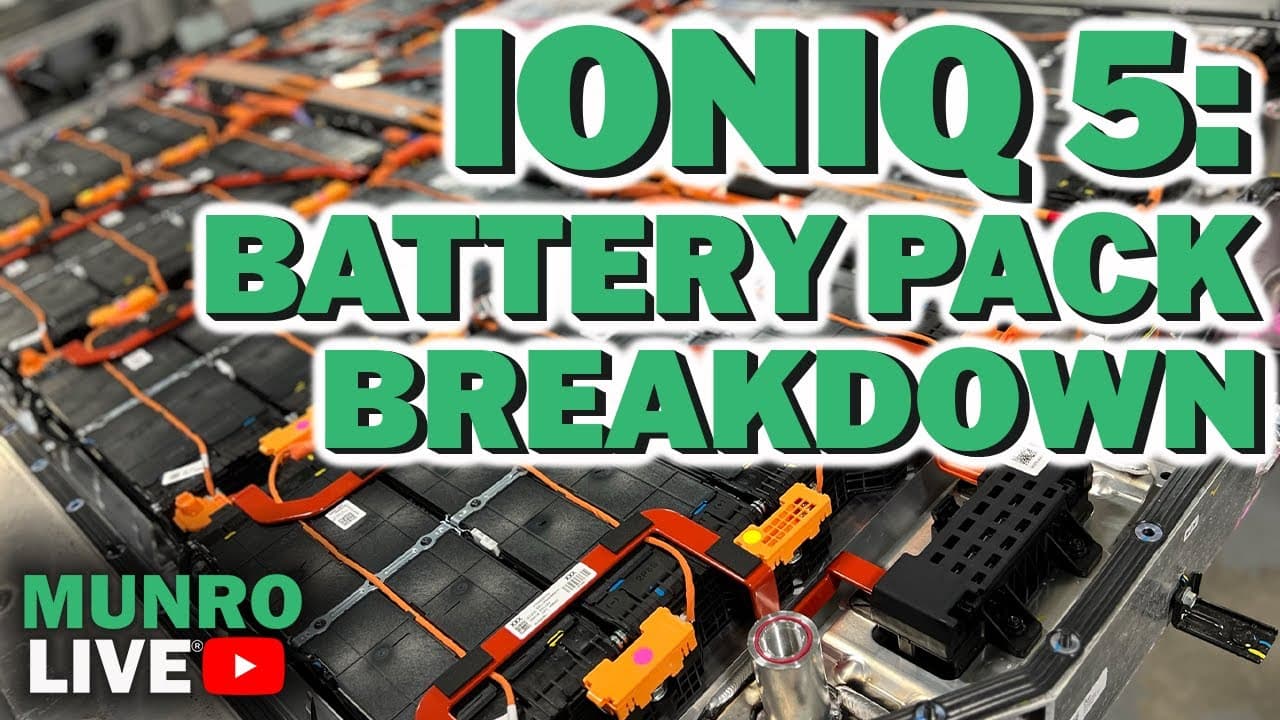
Hyundai's Ioniq 5 pack takes integration further without abandoning modules. Munro's engineers found 32 removable 12-cell modules on an integrated cooling plate stamped into the pack base. Once busbars and low-voltage harnesses were disconnected, they said it was among the easier packs they had opened for module removal. The cost was visible elsewhere: about 10 kg of thermal-interface material, a roughly 3 mm layer between the pouch cells and the cooling surface.
Tesla's Texas-built Model Y structural pack moved the boundary again. Seats, carpet and the centre console were mounted to the battery assembly before it was installed in the body. Munro counted 38 fasteners securing the pack, plus interior interfaces. Dropping the assembly was straightforward, but its role was no longer simply to carry energy. It had become the cabin floor and a manufacturing subassembly.
Blade 2.0 shows the sharp end of integration
The second-generation BYD Blade pack provides a more recent and extreme case. A Chinese teardown team reported freezing the pack for about 40 hours to make its structural adhesive brittle, then spending roughly eight hours cutting, grinding and hammering it apart. The team, which said it had opened more than 20 packs, called this the most difficult.
That difficulty accompanies real packaging work. The teardown found 170 cells in series, extensive internal reinforcement, integrated battery-control hardware and direct refrigerant cooling that reduces the need for a separate liquid circulation pump. Battery Design calculated 179.4 Wh/kg at cell level from the measured 2.48 kg cell mass and the pack's reported 75.6 kWh capacity. Those figures are teardown-derived rather than BYD-certified specifications, but they help explain why engineers tolerate the glue: less inactive structure leaves more room for energy storage.
The pack also endured the destructive dismantling without catching fire or exploding, according to the teardown account. Repairability and crash or thermal safety are not simple opposites. Adhesive can improve stiffness, seal cells and help control movement, even as it makes clean separation harder.
The factory saving can migrate downstream
The Nature review estimates that integration may remove about US$600 in manufacturing cost per vehicle, then contrasts that with a pack capital value of roughly US$5,000 to US$9,000. A saving on parts and assembly can therefore be overwhelmed if a small damaged region forces replacement of the complete pack.
Research from Graz University of Technology points to a practical alternative rather than a return to bulky boxes. The E-Track team compared sealed, replaceable-lid and liquid-filled battery housings, mainly on electric two-wheeler packs, and found repair-friendly designs become environmentally worthwhile when only 8% of cells can be reused. The methods, the researchers say, transfer to cars and trucks. Cells account for around 75% of battery mass in its studied designs. The researchers also paired electrochemical impedance testing with virtual models to identify hidden damage such as micro-shorts, addressing the reason manufacturers are wary of reusing cells after a crash.
The Ioniq 5 teardown shows that an integrated cold plate and removable modules can coexist. The Blade teardown shows what happens when every interface is optimised for first assembly and structural performance. Selective integration — sharing structure and cooling where the mass saving matters, while keeping replaceable covers, diagnostic access and deliberate separation points — is the more honest engineering target.
Buyers will not see grams of adhesive or cooling-channel geometry on a specification sheet. They may eventually see the consequences in insurance decisions, collision write-offs and second-life value. Disassembly time, recoverable-cell yield and repair granularity now belong on the same line as energy density.
- https://www.nature.com/articles/s44359-026-00185-y
- https://techxplore.com/news/2026-08-oil-cooling-ev-batteries-safer.html
- https://carnewschina.com/2026/05/18/byd-blade-battery-teardown-reveals-170-cell-pack-after-40-hour-freeze-team-defends-8-hour-dismantling/
- https://www.batterydesign.net/2026-byd-short-blade-2-0/
- https://www.youtube.com/watch?v=xafeXw9YrZk
- https://www.youtube.com/watch?v=5PASNQU5RSw
- https://www.youtube.com/watch?v=FXpfU6I_T3w
More from the file

Sodium-ion batteries are closing in on LFP cost parity, and the last excuse is energy density
CATL expects sodium-ion to match LFP on cost by the end of 2026. The chemistry's remaining problem is density — and two 2025 research papers just attacked it from different angles.

ProLogium's solid-state cell passed the tests. Its factory makes 0.5 GWh a year
A 381 Wh/kg all-solid-state cell is now in commercial production in Taiwan, validated by TUV and UL Solutions. The output is roughly 6,000 car packs a year.

Donut Lab's 409 Wh/kg result is real. It still does not prove the chemistry
VTT measured exceptional energy density from one Donut Battery cell. The report validates the number, but not solid-state chemistry or production readiness.