MG Hector Tomahawk EV battery rental: the break-even maths
Battery-as-a-Service cuts up to Rs 6.01 lakh off the Hector Tomahawk EV's price. Run the break-even and the scheme only beats a five-year loan below about 2,500 km a month. MG says uptake across its portfolio remains below 7 per cent.
By EV News Desk
MG's new three-row electric SUV in India, the Hector Tomahawk EV, has two prices. One is Rs 19.5 lakh. The other is Rs 13.99 lakh plus Rs 4.90 for every kilometre you drive.
The second number is Battery-as-a-Service, and MG has been the loudest advocate for it in India since the Windsor launched with the same structure. You buy the car without the battery, and you rent the battery by the kilometre. The upfront saving is real and large. On the Hector Tomahawk EV it runs from Rs 5.51 lakh on the base Excite to Rs 6.01 lakh on the Exclusive and both Essence variants, according to Autocar India's variant breakdown published on 26 August.
So how far do you have to drive before the rental costs more than the discount saved?
The arithmetic nobody puts in the brochure
Divide the gap by the rate. On the Excite, Rs 5.51 lakh at Rs 4.90 per kilometre is 112,449 km. On the higher trims, Rs 6.01 lakh works out to 122,653 km. Drive 15,000 km a year and you cross that line during year eight, still not owning the battery, still paying Rs 4.90 for every kilometre after it.
That comparison is not quite fair to BaaS, and MG would rightly say so. Its own FAQ states that the rental bundles both interest and principal, so the honest benchmark is not a cash purchase but a loan for the same Rs 6.01 lakh. Finance that at 9 per cent over five years and the EMI is roughly Rs 12,475 a month by our calculation. At Rs 4.90 per kilometre, BaaS costs less than that up to about 2,545 km a month, or 30,500 km a year.
Which sets up the real decision. Below roughly 2,500 km a month, BaaS genuinely lowers your monthly outgoing. Above it, you are paying more than a loan would cost, and the loan ends. That is a narrower window than "reduces the upfront cost" suggests, and it points squarely at the low-mileage urban buyer — the one for whom a 69.2 kWh, 517 km MIDC-rated SUV is arguably more battery than the job requires.
The terms are where it gets specific
MG's published Windsor BaaS FAQ, which sets out the mechanics of the same programme, is more revealing than any launch slide. Financing must come through the tie-up partners — Bajaj Finance, HeroFinCorp, VidyutTech and Ecofy — and the company states plainly that arranging finance through your own bank is not possible, because these are tailor-made plans. A telematics device is fitted to the vehicle to track monthly kilometres.
Some financiers impose a minimum monthly running of 1,500 km. MG's own FAQ addresses the buyer who does 10 to 15 km a day and asks why they should pay for 1,500, and the answer is to pick a different partner: VidyutTech, it says, charges exactly on the kilometres you run. Useful to know before signing, and not something you would discover from the headline rate.
Resale is the other clause worth reading twice. The programme does not transfer to a second owner. If you sell before the tenure ends, you repay the outstanding amount on both vehicle and battery. Whatever BaaS does for month one, it does not hand you a car you can simply pass on.
MG's own numbers on take-up
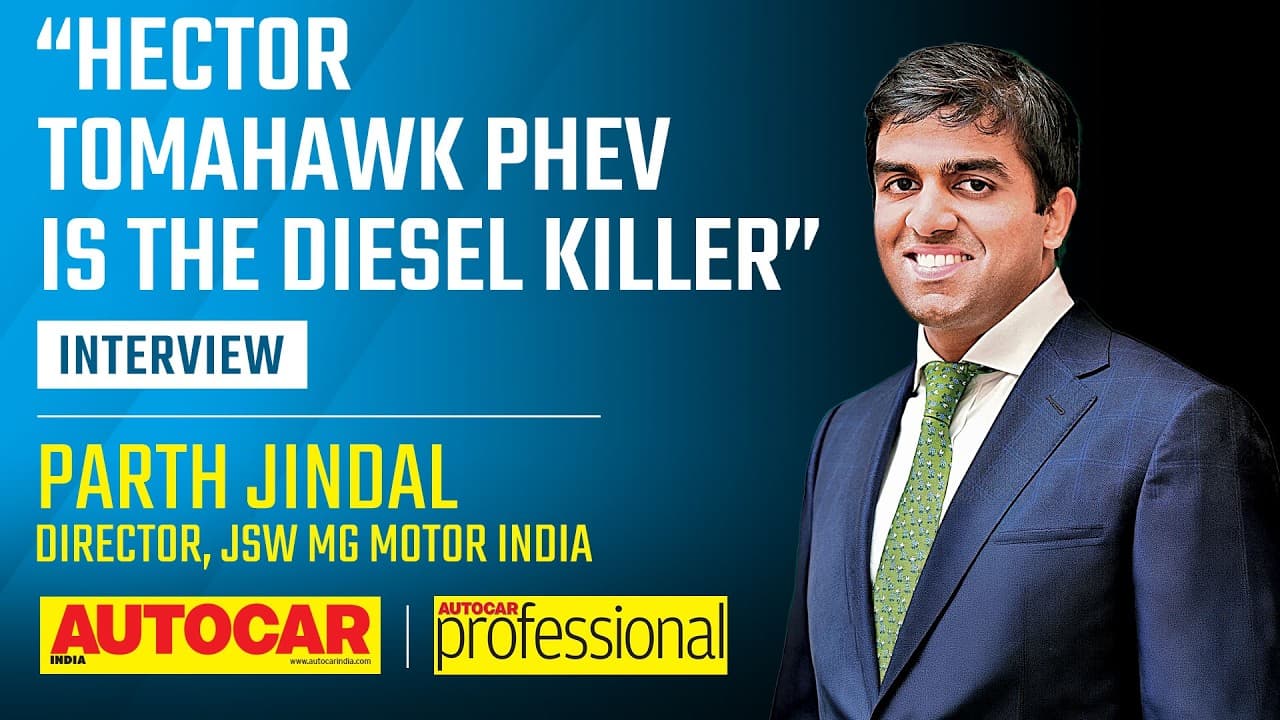
In an Autocar India interview at the launch, the interviewer put it to MG Motor India's Parth Jindal that BaaS uptake across the portfolio is still under 7 per cent despite MG pioneering it, and asked whether the scheme is more than a marketing strategy.
Jindal did not dispute the figure, and his answer reframed the purpose entirely.
“BaaS is more about educating the customer that you need to put fuel into an engine and that costs a lot of money, or you have a battery which consumes only electricity, which is a lot cheaper,” he said. “So when you want to do an apples-to-apples comparison on costing, you look at an ICE in its full avatar because you have to pay that much extra for fuel versus you look at a new energy vehicle which has a battery where the fuel cost is zero, I mean, very, very low. And that's why I believe EV adoption has increased so much.”
Read that as an executive saying the quiet part: BaaS is primarily a device for making the sticker price of an EV land next to the sticker price of a petrol car in a showroom comparison. On that measure it works. Rs 13.99 lakh for a seven-seat electric SUV is a number that stops people walking past. Jindal did not dispute the interviewer's statement that fewer than 7 per cent of MG customers take the plan.
What the rest of the car looks like
Underneath the pricing, the Tomahawk EV is conventional and reasonably specified. All trims share a 69.2 kWh pack driving a 204hp, 310Nm front motor, 0-100 kph in a claimed 8.2 seconds, 517 km on the MIDC cycle. MG quotes 35 minutes for 30 to 80 per cent on a 90 kW DC charger. The Essence adds Level 2 ADAS and V2L, V2V and V2H support.
MG also launched a plug-in hybrid twin on the same body, with its own BaaS rate of Rs 3.20 per kilometre against a 20 kWh pack. Jindal called it “the diesel killer” and expects roughly a 50-50 split between the two drivetrains within a combined capacity of about 6,000 units a month. His reasoning on why the hybrid matters was blunt: EV adoption in India was 4 per cent last year and is trending at 8 per cent this year, likely closing near 10. “That still means you have 90 per cent of the public buying either diesel or petrol.”
For the 10 per cent already convinced, BaaS is a financing product with a mileage ceiling attached. Work out where your own annual kilometres sit against 30,500 before you let the Rs 13.99 lakh do the deciding.
More from the file

A 234,000-mile Lightning gets a used battery. The repair matters more than the mileage
Out of Spec Renew replaces a high-mileage Lightning battery after a module fault. Ford warranty terms and fleet data explain what this repair can tell owners.

Audi Offers Up to $10,000 Off Lease Buyouts for Its EVs
A 1 September dealer bulletin cuts thousands from contractual buyout prices for Audi EV lessees and gives dealers $500 per completed deal. The discount is real, but lessees still need to compare it with market value.

EVs cost 33% less to drive in Europe, unless you have nowhere to park
The ICCT's EV Transition Check 2026 has a headline number and a footnote. Drivers who charge at home save a third on energy. Drivers who rely entirely on public chargers save five per cent.