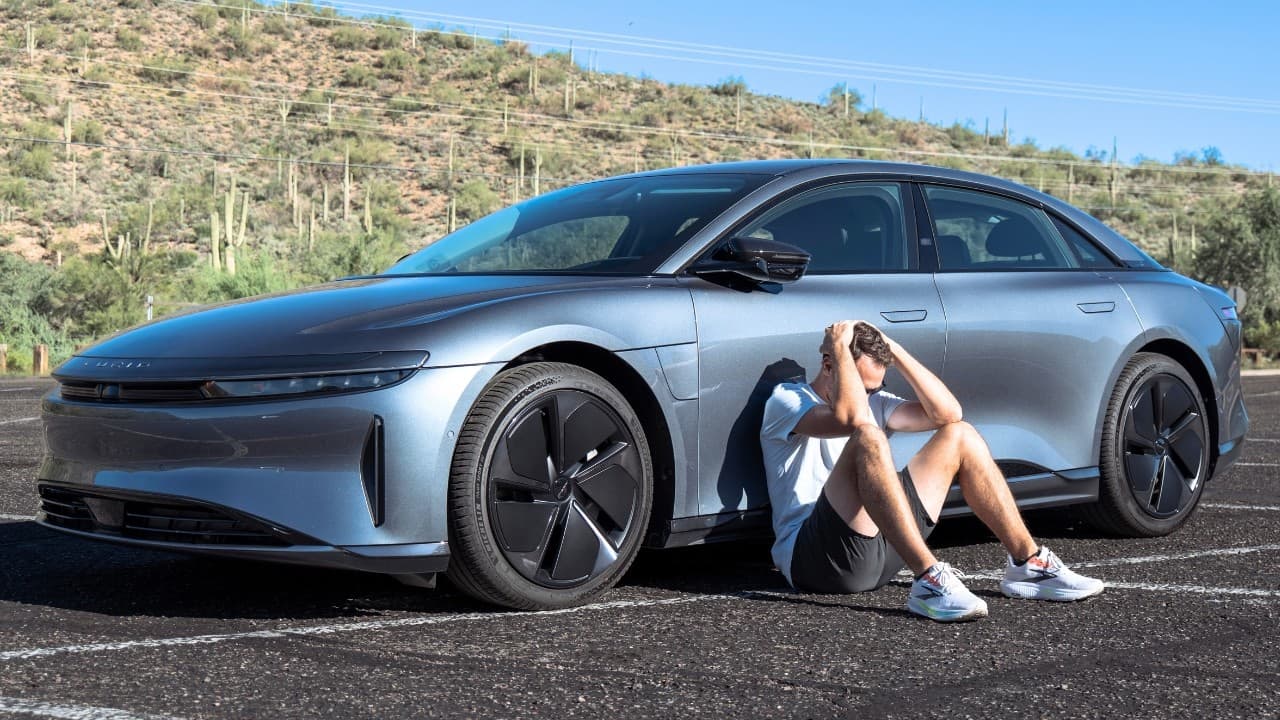
Lucid's biggest recall is a software fuse on the lights. 6,466 Airs still need it
NHTSA 26V540 covers 27,185 Lucid Airs after an eFuse left exterior lighting circuits energised. Three fires and four smoke reports are on file. The OTA fix shipped in July.
By EV News Desk
The consumer advisory on Lucid recall 26V540 is Park Outside, not Do Not Drive. The defect is not the traction battery. It is the software that stands in for a fuse on the Air's low-voltage exterior lights.
Lucid USA filed the Part 573 report on 20 August covering 27,185 Air sedans from the 2022 through 2026 model years, built between 11 October 2021 and 27 July 2026. The company told the agency that the eFuse logic on those lighting circuits could leave a faulted circuit energised at excess amperage. Overheating can produce smoke or fire. The lights can also fail, which raises a crash risk of a more ordinary kind.
It is the largest recall Lucid has issued. As InsideEVs pointed out, 27,185 cars is more than the 15,841 the company sold in all of 2025. The site counted it as the Air's fourth recall this year, after a rear-view camera campaign in January, a half-shaft bolt campaign in March and a drive-unit inverter campaign in May.
Three fires, four smoke reports, a stop-lamp harness
The chronology in the filing is slower than the headline. In June 2023 a Lucid-owned 2023 Air burned at the front left corner. A third-party expert could not pin a root cause and could not rule out the front combination lamp. In May 2026, after a customer 2024 Air caught fire in the same corner, the Product Safety Working Group opened a review. The company then listed three front-lighting fires across three years. The third, in March 2025, involved a 2022 Air and was thought to have started in the front left light-blade controller. No injuries are recorded in the report.
Separately, from October 2025 to April 2026, four owners reported smoke from the centre high-mounted stop lamp circuit. Lucid also logged 33 warranty claims for CHMSL wire-harness damage that could be related. The investigation found gaps in overcurrent protection on those low-voltage lighting circuits. Warning signs, the filing says, can include smoke, a burning smell or telltales for a lighting malfunction.
There is no conventional fuse on those circuits. Lucid uses a software-controlled eFuse. When the logic is wrong, the circuit does not open. It stays live.
The fix shipped in July. The recall followed in August
Software 2.10.0 went out over the air in July. It lowers the eFuse amperage threshold and kills a retry path that could re-energise a faulted circuit in the same key cycle. Lucid's Product Safety Executive Council classified the issue as a safety defect on 13 August and named 2.10.0 as the remedy. By the time the 573 report was prepared, telematics showed 20,719 customer cars already on the remedy version or later. That left 6,466 still on older code.
Owners of those 6,466 are the ones the park-outside line is for. Lucid advises parking away from structures until the car reports 2.10.0 or newer. The update is free. Cars still on older software will get a first-class letter, planned for 16 October, with instructions to take the update or call customer care. Inventory and factory cars were being flashed to 2.10.0 from 27 July, before delivery.
Electrek's Jameson Dow argued that headlines about a fire-risk EV skipped the part where the hardware in question is an LED lighting circuit, and that most of the fleet had already received the patch. That is a fair reading of the numbers. It is also how a software-defined car can sell for four years with an eFuse that does not open, then fix the gap from a server. The Air does not need a new lamp. It needed the code that was supposed to protect the lamp to behave like a fuse.
If you own an Air, the useful check is the software version in the car or the Lucid app, not the garage ceiling. Version 2.10.0 or later is the all-clear in the filing. Anything older is the park-outside population until the packet lands.
- https://static.nhtsa.gov/odi/rcl/2026/RCLRPT-26V540-2255.pdf
- https://www.reuters.com/legal/litigation/lucid-recall-more-than-27000-luxury-sedans-over-fire-risk-nhtsa-says-2026-08-28/
- https://www.caranddriver.com/news/a73554008/lucid-air-fire-risk-recall/
- https://electrek.co/2026/08/30/lucids-fire-risk-recall-was-for-led-lights-already-fixed-by-a-july-software-update/
- https://insideevs.com/news/806421/lucid-fire-risk-recall-27k/
More from the file

Toyota's newest EV can lose drive power. The fix is a dealer visit, not a download
About 10,000 2026 C-HR crossovers in North America can shut down under regenerative braking when the pack is already full. Toyota's patch is software, but it will not fly through the air.

Why Chinese dealers shun five-year-old EVs despite the battery data
About four in five Chinese used-car dealers reject EVs over five years old. Measured degradation and a new battery-health standard show why better diagnostics matter.

Mazda's CX-6e does 240 miles at 80 mph. The platform is still Changan's
Autogefühl's Autobahn loop put 390 km in the CX-6e at 130 km/h. Auto Express scored the cabin and the beeps, then asked whether any of it feels like a Mazda.