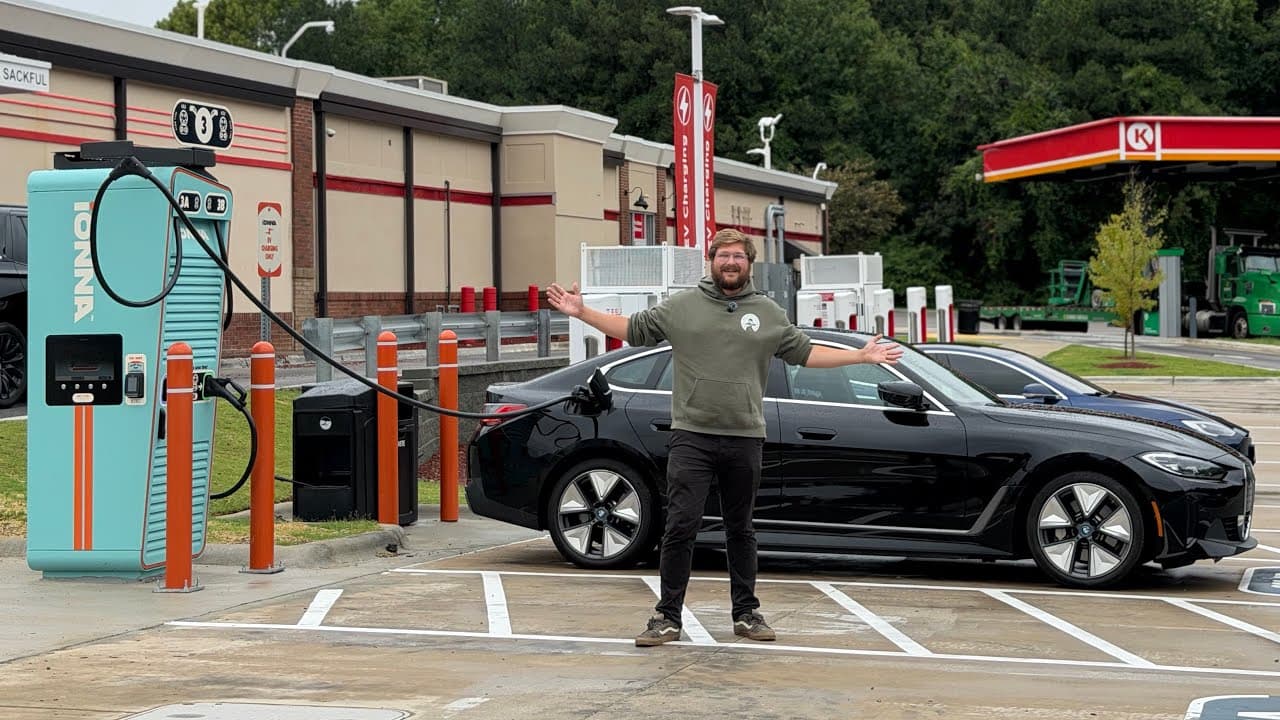
IONNA beat Tesla on charging satisfaction. Now it has to survive scale
IONNA scored 807 in J.D. Power's 2026 charging study with just over 100 live sites. Its Circle K deal will show whether the polished experience survives mass rollout.
A charging network with barely 100 live locations has beaten Tesla at the thing Tesla has owned for years: making a public fast-charge feel routine. IONNA scored 807 out of 1,000 in J.D. Power's 2026 US public-charging study, ahead of Mercedes-Benz at 797 and Rivian at 755. Tesla's Supercharger network placed fourth at 701.
That is a striking result, but not yet a changing of the guard. IONNA is a small, young network being judged at its cleanest moment. Its more consequential number is 350, the ambition for sites it will operate with Circle K. Turning a showcase into a chain is where chargers, payment systems and maintenance regimes usually acquire their scars.
The score rewards the whole stop
J.D. Power did not run a charger drag race. Its index draws on responses from 6,594 battery-electric and plug-in hybrid owners collected from January through June, and covers ten factors. Speed matters, but so do availability, physical condition, safety, payment, cost, finding the site and having something to do while the car charges.
That methodology suits IONNA's pitch. Its Rechargeries provide CCS and NACS connectors, advertise up to 400 kW, support card payment and Plug & Charge, and are deliberately attached to places with toilets, food and lighting. The study found that fast chargers at hotels scored 692, convenience stores and fuel stations 689, and restaurants 688. Dealership chargers managed 570, while stand-alone car parks and garages scored 606.
The charging dispenser, in other words, is only half the product. Out of Spec Reviews' visit to the Wilson, North Carolina Circle K site put an IONNA representative on location to explain the two companies' rollout. State of Charge separately examined IONNA's planned takeover and upgrade of Circle K's existing charging estate. Both field reports centre on a useful piece of infrastructure that specification sheets overlook: a functioning shop already staffed for long hours.
A small network gets the new-network advantage
The 807 should still come with an asterisk. IONNA said in March that it had crossed 100 live locations and was approaching 1,000 bays. By comparison, the US Department of Energy's Alternative Fuels Data Center listed more than 40,000 Tesla Supercharger ports across the United States and Canada in its July network import. The databases are not perfectly like-for-like, but the difference in operating scale is enormous.
J.D. Power executive director Brent Gruber acknowledged the structural advantage. Newer networks have fresh hardware and locations selected around the current driver experience. Age brings weather, vandalism, obsolete parts and years of hurried repairs. A network can also be selective while it is small, then accept less ideal sites when a rollout target starts driving decisions.
The wider results show that the improvement is real, not merely an IONNA halo. Satisfaction with DC fast charging rose 12 points to 666, and unsuccessful visits fell to a study-record low of 12%, from 14% a year earlier. Availability delivered the largest year-on-year improvement, up 27 points. Safety and charging cost each improved 18 points.
Circle K is the replication test
IONNA's Circle K agreement is designed to remove the site-selection bottleneck. The plan calls for more than 350 Rechargeries at Circle K stores, including the conversion and upgrade of roughly 85 existing charging sites. The first co-branded locations are due to begin service by the end of 2026, with more following in 2027. Circle K has more than 7,300 US stores, so there is room to grow without inventing a roadside retail operation from scratch.
The arrangement also exposes IONNA to the less glamorous work behind a national network. Existing electrical services differ. Parking geometry differs. Local utilities and permitting offices move at different speeds. A charger layout that works beautifully at a purpose-built Rechargery may have to share a busy forecourt with fuel customers and delivery trucks.
IONNA says it has 4,700 bays contracted, nearly 1,500 in construction or beyond, and a goal of 30,000 high-power bays by 2030. Its Circle K announcement promises both connector standards and charging up to 400 kW. Those are sensible design decisions, but they do not guarantee that every converted site will have enough working stalls on a holiday weekend.
Price is part of the experience now
A recent Tesla-owner test by the Rocco Rides Tesla channel framed IONNA as cheaper than the nearby Supercharger option used for comparison. That is a useful field observation, not a national tariff survey: fast-charging prices vary by site, time and membership. It does show why IONNA's lack of a mandatory subscription resonates. Drivers can pay by card, while participating automakers can layer their own discounts and charging credits on top.
J.D. Power's parallel finding on slower Level 2 charging makes the contrast sharper. Level 2 satisfaction fell 12 points to 595, with payment and ease of charging pulling it down. Only 34% of Level 2 users reported a free session, compared with 60% in 2023. As free destination charging disappears, a clumsy app or payment screen is harder to forgive.
IONNA has shown that a charger can be treated like one part of a proper travel stop, not electrical equipment abandoned at the edge of a car park. The next phase is less photogenic: reproduce that experience hundreds of times, keep yesterday's hardware working, and answer the phone when it does not. Its 807 is a benchmark. Circle K will decide whether it becomes a system.
- https://www.youtube.com/watch?v=1FXWM-t2FPw
- https://www.youtube.com/watch?v=nloQxA1RONI
- https://www.youtube.com/watch?v=m9wsfr5MLMQ
- https://www.jdpower.com/business/press-releases/2026-u-s-electric-vehicle-experience-evx-public-charging-study/
- https://www.ionna.com/news/ionna-and-circle-k-enter-partnership-to-expand-access-to-ev-charging-in-the-u-s-at-ionna-rechargeries-circle-k/
- https://www.ionna.com/news/ionna-celebrates-second-anniversary-with-bold-moves-and-promises-filled/
- https://afdc.energy.gov/stations/charging-networks
More from the file

Waymo's Las Vegas robotaxis are queuing at public chargers, and drivers noticed
Days after Waymo opened to public riders in Las Vegas, ride-hail drivers reported waits of up to 90 minutes at an Electrify America site. Waymo says it limits its public charging.

New York hands its curbside charging buildout to a Brooklyn startup
The city picked Brooklyn's it's electric to build a curbside Level 2 network aimed first at ride-hail drivers who park on the street. Pricing has not been set yet.

IONITY's Greenwich hub brings 400 kW to the weekly shop. Will the bill fit?
A new Mr. EV visit tests the promise of IONITY's urban expansion: useful locations and powerful chargers, with price and the car itself deciding everyday value.