GM shifts Spring Hill to prismatic LMR, with the proof still ahead
Ultium Cells will retool its Tennessee plant for prismatic LMR cells by 2028. The 33 percent density claim is GM's own, and the durability questions are still open.
Prepared by the Industry Desk · how our desks work
General Motors is turning its Spring Hill, Tennessee, battery plant into what it says will be the first factory anywhere to mass-produce prismatic lithium-manganese-rich (LMR) cells. The reason is cost: GM wants a cell that is cheaper than the high-nickel packs in its trucks without giving up the range that lithium iron phosphate (LFP) costs it. Ultium Cells, the joint venture with LG Energy Solution that runs the plant, says work starts later in 2026 and finishes in 2028.
The 2028 retrofit and GM's 33% claim
The claim at the centre of it is that LMR delivers about 33 percent more energy density than LFP "at similar costs," as electrive reported it. Electrek quotes the company saying LMR can "deliver 33% higher energy density than lithium iron phosphate (LFP), the current leading affordable battery tech, and at a comparable cost." Investment across the LMR programme, LFP energy-storage production and site upgrades is put at about $1 billion by 2030. The plant's 1,200-strong workforce gets 500 more jobs, taking it to 1,700.
GM Vice President Kurt Kelty framed the chemistry as a way to "leapfrog today's more affordable chemistries and deliver lower costs with better performance." The first vehicles are electric trucks and full-size SUVs, with GM targeting more than 400 miles of range.
Why GM is skipping LFP for trucks
The announcement lands after a strategic turn. In June, electrive reported Kelty saying "There is a possibility where LFP does not earn its way into our portfolio." Spring Hill began making LFP cells that month, but only for stationary energy storage, not for vehicles.
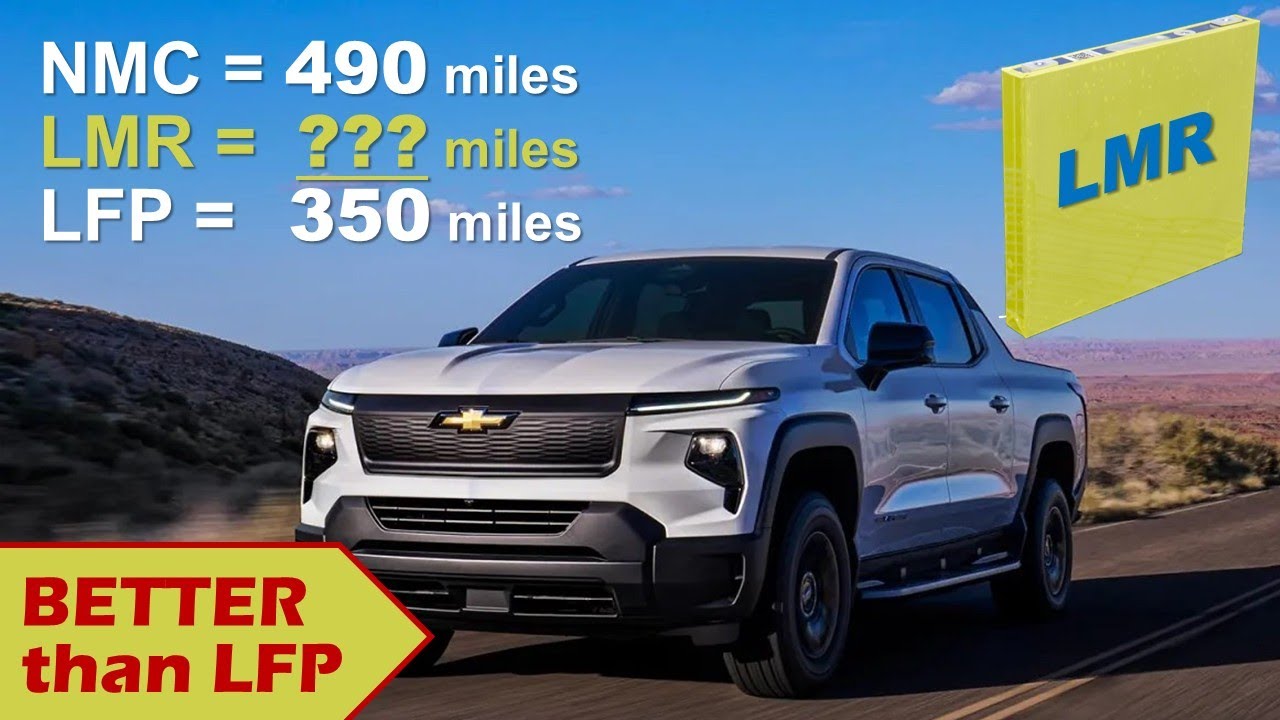
The economics explain the hedge. Mike the Car Geek, covering Kelty's talk at The Battery Show in Detroit in October 2025, recalled that a Silverado EV with the high-nickel pack carries a 490-mile EPA rating, and that an LFP pack briefly appeared in the order guide at 350 miles. He said earlier GM presentations put that LFP pack about $6,000 cheaper. His read was that LMR is meant to keep most of that saving while holding range above 400 miles. That is a creator's recollection of GM's earlier figures, not a number from this week's release.
The cell format matters too. The same video notes LMR comes in a large prismatic format, which suits a big truck pack better than a small car. Mike the Car Geek said that would make packaging in something like the coming Bolt EUV "kind of difficult." Kelty was also asked about LMFP, the manganese-doped LFP some Chinese makers are exploring, and according to the video he said LMR holds advantages over it.
The part nobody has proven
LMR has a long history in laboratories, and the problems that kept it there have not vanished from the coverage. Electrive's September report lists "durability, capacity loss, and limited fast-charging capability" as outstanding issues. GM and LG have said their answer is proprietary doping, coatings and particle engineering. The coverage describes that as a claim of parity with current nickel-cell pack life, not a published test result.
The 33 percent figure is also GM's and LG's own, quoted by every outlet from the same company statement. No independent cell test of the production prismatic format is cited in any of the coverage.
Where the sources disagree
The timeline has moved. The October 2025 video has Kelty describing LMR going into large EVs in 2027. The current announcements say the first LMR vehicle arrives in 2028, with the plant retrofit not complete until that year. Whether that reflects a deliberate sequencing of tooling or a slip, none of the sources says.
The supply argument is steadier. Electrive notes GM's case that LMR can lean on North American lithium, graphite and manganese, and that LG has held more than 200 LMR-related patents and researched the chemistry since 2015. Manganese substitutes for the cobalt and much of the nickel in high-nickel cells, which is where the cost story starts. Electrive adds that Ford also sees significant potential in LMR, so GM is not the only Detroit maker watching the chemistry.
What to watch
Three things will settle whether this is a cost breakthrough or an expensive pilot. First, cycle-life and fast-charge data on the production prismatic cell, preferably from someone other than GM and LG. Second, the pack price GM quotes once the first truck is priced. Third, whether LFP for vehicles quietly returns if LMR slips again, since the plant will keep making LFP, high-nickel and LMR cells in both pouch and prismatic formats and can shift the mix.
For now the verifiable facts are a $1 billion commitment, a 2028 finish line, a 33 percent density claim from the companies making the cells, and a list of unsolved engineering issues that the same coverage repeats.
- https://www.electrive.com/2026/09/30/ultium-cells-retrofits-tennessee-plant-for-lmr-cell-production/
- https://www.electrive.com/2026/06/12/gm-advances-lmr-battery-cells-as-lfp-plans-fade/
- https://electrek.co/2026/09/29/gms-new-ev-battery-tech-cut-costs-without-sacrificing-range/
- https://www.just-auto.com/news/ultium-cells-upgrade-spring-hill-plant/
- https://www.youtube.com/watch?v=18xpFrslWME
More from the file

KBA's three VW battery campaigns sit behind the 80% cap
German regulator records put about 72,700 Volkswagen Group electric cars into three battery campaigns, covering ID.3, ID.4, ID.7, ID. Buzz and Cupra Born. The UK instruction is to stay at 80 percent. The US ID.4 filing is a separate notice.

BMW opens Shenyang Gen6 line as the 1,213 km test stays uncertified
Series production of BMW sixth-generation packs is underway in Shenyang for China-built Neue Klasse models. The 1,213 km i3 run was the company's own road test.

VW and Gotion Split Three Plants to Fill Europe's LFP Gap
Volkswagen is selling 49% of PowerCo's Valencia cell plant to Gotion and buying into Slovak and Moroccan factories, because Europe still has no meaningful LFP production of its own.