Why one failed EV battery module can still trigger a whole-pack quote
A Nissan Leaf case, an independent UK workshop and CATL repair rollout show why service access, not just battery health, shapes used-EV risk.
By EV News Desk
Two quotes, one car. A first-generation Nissan Leaf in Australia drew a A$33,000 dealer quote for a replacement pack. After the case attracted publicity, Nissan offered the owner a subsidised battery exchange at A$9,990 plus fitting. John Cadogan documented the case, and Aussie Auto Watchdog revisited it this week. These were not identical transactions at different counters: one was a retail replacement quote, the other a subsidised exchange. The gap still exposes the risk facing used-EV buyers when a workshop can quote only a complete pack.
That spread is the question hanging over the wave of off-lease electric cars now landing on used lots. Not what a pack costs, but what happens when a service adviser looks at a car one day out of warranty and reaches for the only part number in the system.
The single part number problem
Aussie Auto Watchdog's presenter makes the mechanical point plainly: a traction battery is usually catalogued as one part, the module underneath it often cannot be ordered locally, and working inside a live high-voltage pack requires competency units most workshops do not hold. A service adviser quoting a whole pack is not necessarily gouging. From where they sit, there is only one answer.
Raymond, who runs the Raymond EV Garage channel and fields owner questions daily, argues the other side of that coin. A pack is not one battery but thousands of cells, he says, and short of a fire the idea that all of them fail together does not survive contact with the workbench. His own answer to “what does a battery cost” is that nobody can tell you without knowing the exact car and year.
What the repair actually looks like
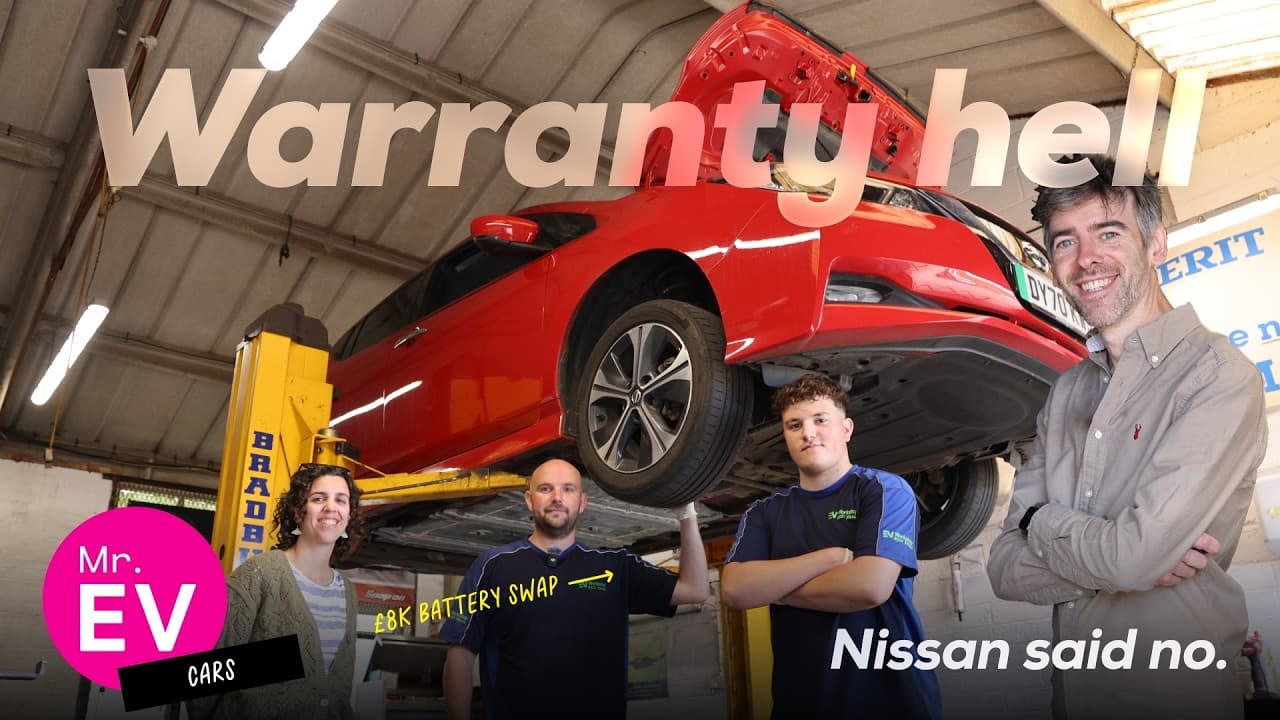
The counterweight comes from a British workshop floor. At the EV Workshop in Herne Bay, Kent, presenter Andrew Till filmed the swap of a 40kWh Leaf pack belonging to an owner named Jade, whose warranty claim Nissan had refused. “It was actually one day over the five-year warranty,” she said.
Her symptoms are the ones early-Leaf owners know. “As I went through and the battery depleted, I’d noticed the percentage was fluctuating very rapidly,” she told Till. “You think, oh, you know, you’ve got 50% battery left, that’s plenty to get home, and then suddenly it say 20, 30, 20, and you’re panicking a bit.” A car bought on the expectation of roughly 180 miles was, she said, delivering “at most 50 miles.”
The workshop’s technician treated it as routine. “It’s a very typical symptom of early battery failure where once the charge drops below around 50% the predicted range fluctuates all over the place,” he said, adding that the same pattern runs through the fleet of e-NV200-based London taxis the shop maintains, most commonly between 70,000 and 100,000 miles, and that thermal management on those van packs has not prevented it.
His refurbishment figure is worth writing down. A full module replacement using new Nissan parts runs “around between sort of seven and a half, eight thousand pound.” Expensive — and yet the taxi drivers keep coming back. Even factoring in a refurb every four years, the technician said, they tell him it beats running a diesel cab once clutches, injectors and turbochargers are counted.
Not every job is clean. One pack sat in the shop for weeks because cell swelling had bowed the battery management unit, which then read cell voltages incorrectly and stopped the van starting. The replacement BMU came from Japan.
CATL takes repair to an assembly line
CATL subsidiary Ning Service is trying to turn that specialist work into a network. In its August announcement, the company said it would reach 100 cities by the end of 2026, using robotic lines to cut, paint and reseal packs. Figures reported from the announcement put a complete replacement at about US$14,800 and a cell-level repair near US$1,480, with a three-day service-centre target. Mobile trucks carry 30 diagnostic routines and 50 repair procedures; Ning Service says they can handle 90% of non-deep repair cases within 48 hours.
The infrastructure is not hypothetical: 1,376 franchised service points across 84 countries, with repair centres running in Norway and Istanbul. Coverage of models sold in China has climbed from 47% to nearly 77%, and newer sites accept vehicles regardless of whose cells are inside.
The Electric Viking, who covered the announcement, was equally direct about the limits. Packs bonded with structural adhesive — Tesla’s 4680 assemblies and BYD’s second-generation Blade among them — are close to impossible to open, so a repair-friendly network does not make every car repairable. He also flagged the obvious hole: CATL has not published per-repair pricing.
The quote depends on the repair route
Repairability sets residual values. A 2023 Reuters investigation found insurers across the US and Europe writing off low-mileage EVs after minor collisions because nobody could properly assess or repair the pack, and the Electric Viking cited Allianz figures putting battery damage at roughly 8% of German claims costs — wildly out of proportion to the number of claims. Those write-offs price themselves straight back into premiums and trade-in offers.
Fleet degradation data is calmer than the repair anecdotes. Geotab’s study of 22,700 vehicles across 21 models measured average capacity loss near 2.3% a year. Vehicles that used high-power DC charging for more than 12% of sessions averaged about 3% annual degradation, against roughly 1.5% for vehicles below that threshold. Charging history can therefore add useful context, but it cannot tell a buyer whether a local workshop can replace one failed module.
Paperwork determines which repair route is available. Many manufacturers publish 70% state of health as their capacity-warranty threshold; Mitsubishi’s capacity care programme uses 66%, while Toyota conditions bZ4X battery-capacity cover on scheduled health checks being completed. Aussie Auto Watchdog’s shorthand is useful: on a used car, the service history is the warranty. Buyers should ask for the warranty terms and battery report, then call both the manufacturer network and an independent high-voltage specialist before treating a whole-pack quote as the only price.
- https://www.youtube.com/watch?v=qMS0rumqYng
- https://www.youtube.com/watch?v=Xi00A2hsjG0
- https://www.youtube.com/watch?v=Gk0mT3nT4Ts
- https://www.youtube.com/watch?v=i8ei7dHqq8E
- https://www.notebookcheck.net/EV-battery-repair-price-drops-to-1-480-as-CATL-offers-48-hour-fixes-with-mobile-service.1368565.0.html
- https://www.reuters.com/business/autos-transportation/scratched-ev-battery-your-insurer-may-have-junk-whole-car-2023-03-20/
- https://www.geotab.com/blog/ev-battery-health/
More from the file

A 234,000-mile Lightning gets a used battery. The repair matters more than the mileage
Out of Spec Renew replaces a high-mileage Lightning battery after a module fault. Ford warranty terms and fleet data explain what this repair can tell owners.

Audi Offers Up to $10,000 Off Lease Buyouts for Its EVs
A 1 September dealer bulletin cuts thousands from contractual buyout prices for Audi EV lessees and gives dealers $500 per completed deal. The discount is real, but lessees still need to compare it with market value.

EVs cost 33% less to drive in Europe, unless you have nowhere to park
The ICCT's EV Transition Check 2026 has a headline number and a footnote. Drivers who charge at home save a third on energy. Drivers who rely entirely on public chargers save five per cent.